In a compact apartment or studio, every surface counts. Many people skip wall art because they’re afraid it will make the space feel crowded. The opposite is usually true: the right art in the right place makes a small room feel larger, brighter and more intentional.
1. Go bigger than you think
One large piece makes a small room feel more spacious than several small ones. Lots of little frames break the wall into fragments, which reads as clutter. In a compact living area, a piece around 60×90 cm above the sofa often works better than six 20×25 cm frames.
2. Use vertical art to raise the ceiling
Tall, narrow artwork draws the eye upward. Portrait-orientation prints, a vertical stack of two or three frames, or a long narrow canvas beside a doorway all help. Hang them slightly higher, with the top edge about 30 cm below the ceiling.
3. Choose art with depth and open views
Landscapes, seascapes and long perspectives act like windows. Light, airy palettes help: soft blues, sandy neutrals and pale greens.
4. Pick finishes that reflect light
Glossy acrylic and framed art with a light mount bounce light around the room. Avoid heavy dark frames, which shrink the wall.
5. Light it up
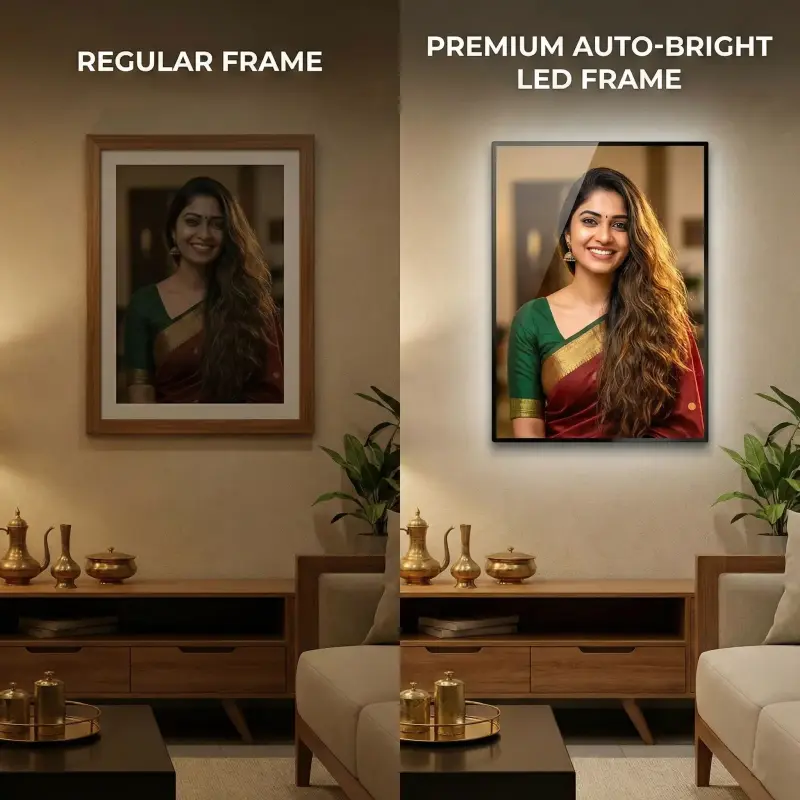
An LED photo frame is a backlit print that glows evenly from behind, so it works as both art and soft ambient light in a reading nook, loft bedroom or passage, with no extra lamp taking up space.
6. Use awkward spots
- A slim vertical print between two windows.
- A small photo at the end of a galley kitchen to make it feel longer.
- A piece at the top of a loft ladder.
7. Keep frames light and fixings minimal
In rented flats, choose lightweight frames, canvas on slim stretcher bars or frameless acrylic. Use adhesive strips rated for the weight, or a single picture rail.
8. Edit ruthlessly
Pick two or three pieces you truly love and rotate others seasonally. Store the rest flat under a bed.
Mistakes to avoid
- Hanging art too high on short walls.
- Very dark, busy artwork in a room with little light.
- Too many frame styles in a tiny room.
Fewer, larger pieces, vertical shapes, open views and art that brings its own light make the biggest difference. Start with a single piece and see how much the room changes.