
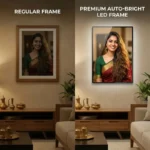


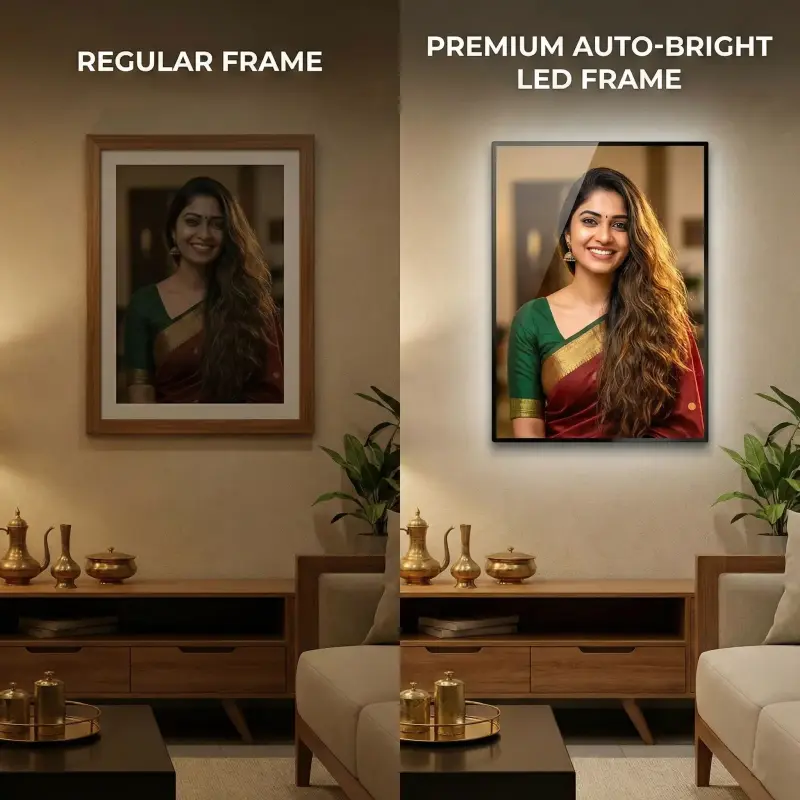
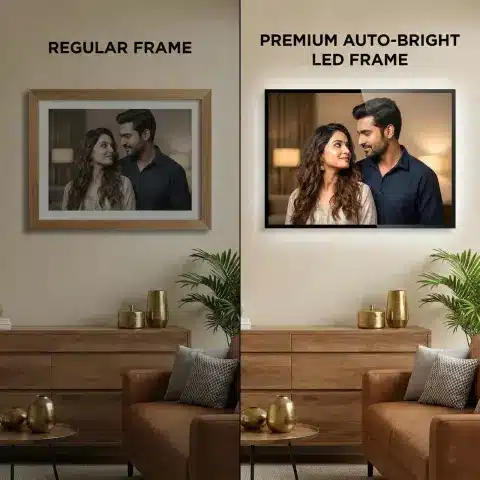
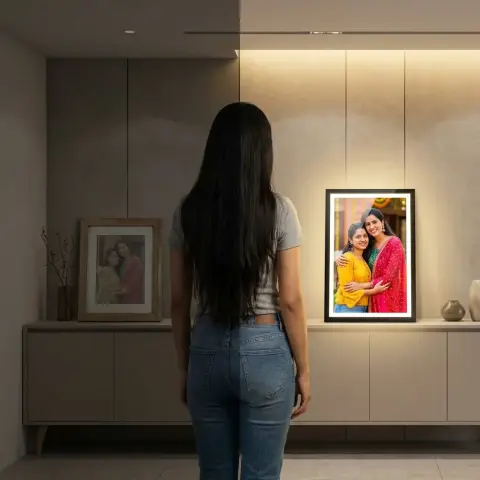
Most framed photographs depend entirely on the room around them. Hang a print in a corridor with one ceiling light and it disappears after sunset. Put it on a wall that gets harsh afternoon sun and the highlights wash out. A photograph in an ordinary frame is only ever as good as the light falling on it, which in most Indian homes means it looks its best for a couple of hours a day and unremarkable for the rest.
An LED photo frame solves that by carrying its own light. The print sits in front of an integrated LED strip and a diffuser layer, so the image is lit evenly from behind rather than relying on whatever the room offers. The result is a photograph that looks deliberate at two in the afternoon and still looks deliberate at ten at night. This guide covers how that construction actually works, the three light tones available, every size on offer, what it costs to run, and where a backlit frame genuinely beats an ordinary one.
What actually makes a backlit frame look premium
The phrase gets used loosely, so it is worth being specific about which parts of the construction do the work. Three things separate a backlit frame that looks expensive from one that looks like a novelty item.
Even light diffusion, not visible hotspots
The giveaway on a cheap light box is that you can see where the LEDs are. Bright patches appear along one edge and the middle of the image stays dull. The fix is a diffuser layer between the LED strip and the print, which scatters the light before it reaches the paper. Done properly, you cannot tell where the individual diodes sit — the whole image lifts at once. This is the single biggest visual difference between a well-made backlit frame and a poor one, and it is the thing to look at first in any photograph of a finished product.
A print made to be lit from behind
Backlighting is unforgiving. Light passing through a print exaggerates everything: banding in a gradient, muddy shadows, a colour cast you never noticed on screen. A print that looks fine on a wall can look blotchy once it is lit from behind. PrintPosters.in uses twelve-colour HD printing on these frames, and the extra inks matter here more than on a standard print, because smooth tonal transitions are exactly what backlighting tests. Skin tones and night skies are where you notice it.
Assembly you cannot see
These frames are hand-finished and quality-inspected at the Pune studio before dispatch, and they ship in multi-layer protective packaging. That matters more for a lit frame than a plain one, because there is wiring and a diffuser inside that a courier can disturb. The hanging hardware and an Indian two-pin adapter are included in the box, so there is nothing to source separately before you can hang it.
Warm white, cool white or RGB: choosing a light tone
You choose the tone before ordering and can preview it on the product page. The three options are not interchangeable, and picking the wrong one is the most common reason a finished frame feels slightly off.
- Warm white is the default and the right answer most of the time. It matches the yellow-toned bulbs used in most Indian living rooms and bedrooms, so the frame reads as part of the room’s lighting rather than competing with it. It flatters skin tones, which makes it the obvious choice for portraits, weddings and family photographs.
- Cool white suits rooms already lit with white or daylight tubes — kitchens, study areas, offices, many newer apartments. It also suits subject matter that benefits from crispness rather than warmth: architecture, cityscapes, black and white work, product photography. In a warm-lit room it can look clinical.
- RGB cycle shifts through colours. It is a different proposition entirely — more of a feature light than a photograph display, and best suited to a child’s room, a games room or a party wall. For a wedding photograph above a bed it will undercut the image rather than support it.
Brightness is separately adjustable from dim to bright, which matters more than people expect. A frame at full brightness in a dark bedroom is a light source, not a picture. Most people settle somewhere in the middle for a bedroom and higher for a living room with competing light.

Every size, and what each one is actually for
Fourteen sizes run from a desk-sized square up to a wall-dominating 36×48 in. All sizes currently carry a 40% discount. Prices below were correct at the time of writing; check the product page for current pricing.
| Size | Price | Suits |
|---|---|---|
| 8×8 in | ₹1,405 | Desk, shelf, bedside — the entry size |
| 8×10 in | ₹1,617 | Desk or narrow shelf, portrait orientation |
| 8×12 in | ₹1,843 | Small wall gap, study nook |
| 12×12 in | ₹2,445 | Square prints, kitchen or hallway |
| 12×16 in | ₹3,047 | Above a bedside table or console |
| 12×18 in | ₹3,348 | Above a bed — the most popular choice |
| 16×16 in | ₹3,800 | Square statement in a smaller room |
| 16×24 in | ₹5,307 | Wider walls, above a sofa |
| 18×24 in | ₹5,835 | Living room feature wall |
| 20×30 in | ₹7,720 | Large living room or stairwell |
| 24×24 in | ₹7,419 | Big square format |
| 24×36 in | ₹10,586 | Dominant wall piece |
| 30×40 in | ₹14,133 | Double-height or commercial wall |
| 36×48 in | ₹19,642 | Showroom, reception, large format |
Sizing to the wall rather than to the budget
The usual mistake is ordering one size down and regretting it. A frame that is too small above a bed or sofa looks tentative, and the glow makes undersizing more obvious rather than less, because the lit rectangle draws the eye straight to its own proportions.
- Above a bed: aim for roughly two-thirds the width of the headboard. For a standard queen bed that lands on 12×18 in or 16×24 in.
- Above a sofa: the same two-thirds rule against the sofa width. Most three-seaters want 16×24 in or 18×24 in.
- Hallway or stairwell: you view these from close range and at an angle, so a smaller frame works harder than it would on an open wall. 12×12 in or 12×16 in is usually enough.
- Desk or bedside: 8×8 in or 8×10 in. At this distance a bigger frame becomes a glare source rather than a picture.
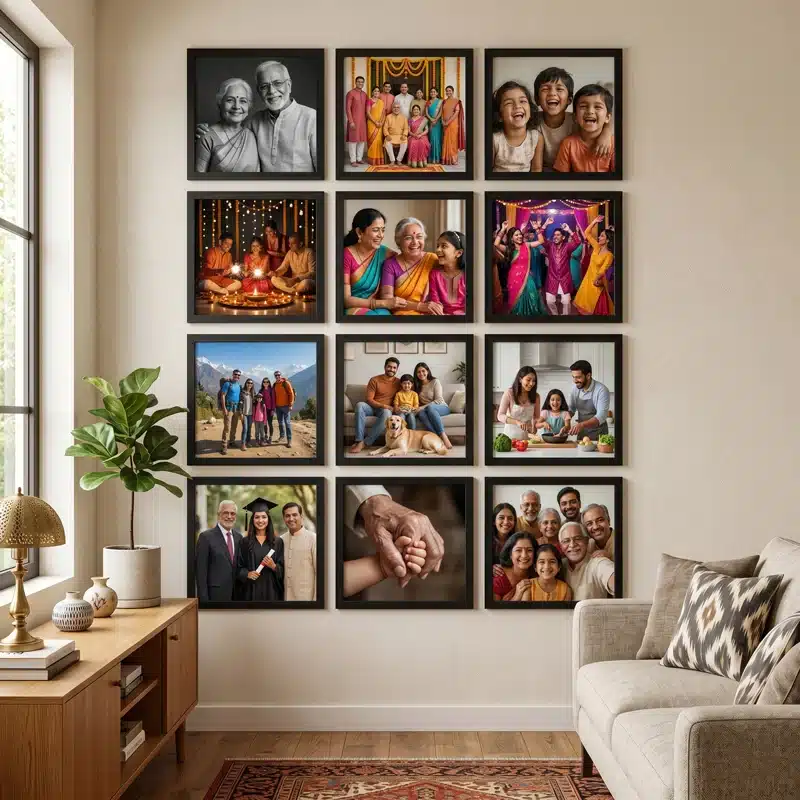
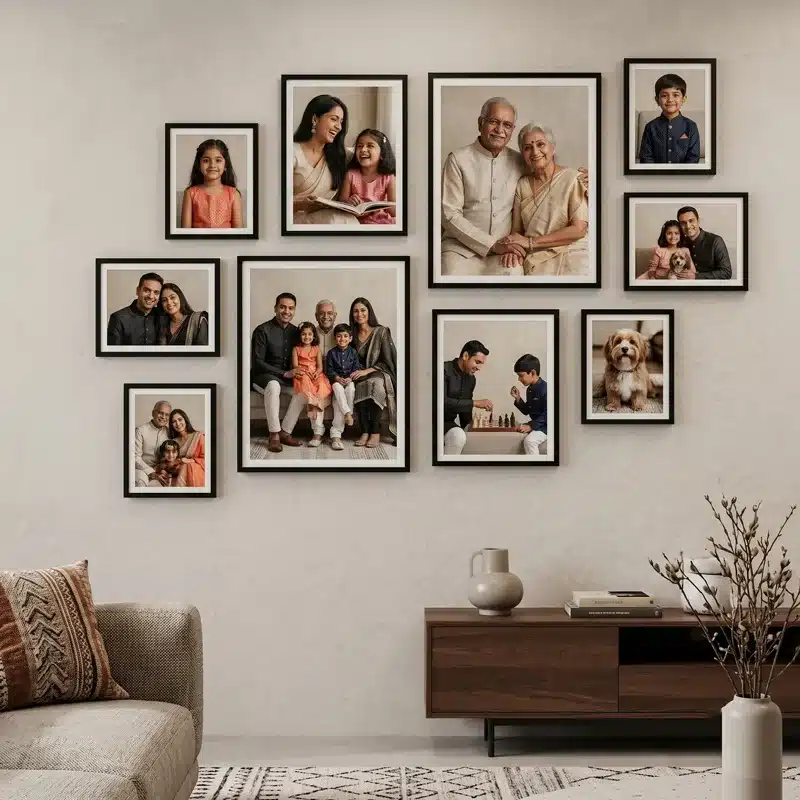
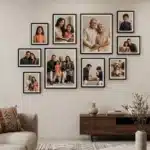
If you are planning several frames rather than one, the arithmetic changes — spacing and centre height start to matter more than individual size. Our step-by-step guide to planning a gallery wall covers the measuring method and the fixings that hold in Indian concrete and brick.
Running cost, heat and lifespan
This is where backlit frames tend to be misunderstood. People assume a lit frame is a meaningful addition to the electricity bill, or that it will warm up a small bedroom. Neither holds.
- Power draw is 5–12W depending on size. For context, that is in the region of a single LED bulb, and well below a ceiling fan. Even left on every evening, the cost is marginal.
- The backlight runs cool. It is described as cool to the touch, which is why these are considered suitable for bedrooms and nurseries. LEDs convert far more of their input into light than filament bulbs did, so there is little waste heat to shed.
- LEDs are rated for 50,000+ hours. Run it six hours a day and that is over twenty years before noticeable dimming. In practice the print and the frame will age before the diodes do.
- It can stay on all day if you want it to. If you would rather it came on at dusk, a wall switch or an inexpensive smart plug handles scheduling without needing anything from the frame itself.
One point of honesty: the LED strips are factory-integrated rather than user-replaceable. This is a genuine trade-off. Integration is what allows the clean back panel and the even diffusion, but it means you cannot swap a strip yourself years down the line. The LED components carry a two-year warranty against manufacturing defects, and support is handled over WhatsApp or email with your order ID.
LED frames compared with acrylic and canvas
These are different products solving different problems, and an LED frame is not automatically the better choice.
| LED frame | Acrylic | Canvas | |
|---|---|---|---|
| Own light source | Yes | No | No |
| Needs a power point | Yes | No | No |
| Look | Glowing, modern | Glossy, sharp, sleek | Matte, textured, classic |
| Glare in bright rooms | Low — it competes with ambient light | Can be high on a glossy face | Very low, diffuses light |
| Best for | Dim corners, evening rooms, feature walls | High-resolution images, contemporary spaces | Artistic and classic subjects |
| Starting price | ₹1,405 | Varies by size | Varies by size |
The practical deciding factor is usually the power point. An LED frame needs one within cable reach, and on a wall with no socket nearby you are choosing between a visible cable run and a different product. If that rules it out, an acrylic print is the closest alternative for a modern look — our guide to acrylic photo frames goes into the material in detail.
Getting the photo right
Because backlighting magnifies flaws, the source image matters more here than on a standard print. A few things help.
- Upload the original, not a forward. A photo that has been through WhatsApp several times has been recompressed each time. Pull the original off the phone or camera where you can.
- Let the quality checker advise the size. The configurator assesses your image resolution and recommends a size it will hold up at. If it suggests smaller than you hoped, that is useful information rather than an obstacle.
- Formats accepted are JPG, PNG, WebP and HEIC — so iPhone photos upload directly without converting anything first.
- AI enhancement is available for sharpening, colour balance and print optimisation. It earns its place on older or slightly soft photographs more than on recent, well-exposed ones.
There are also cinematic filters — Warm Glow, Golden Memory, Vintage B&W, Matte, Wedding Glow, Festival and Soft Portrait among them — plus cropping, solid or blurred backgrounds, and text overlays. Filters interact with the backlight, so it is worth using the preview rather than choosing blind: a filter that deepens shadows will read differently once the image is lit from behind.
More than one photo in a single frame
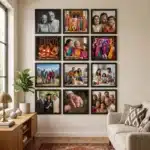
The standard product takes a single photograph, but a collage tool offers layouts if you want several: two side by side, two stacked, one large with two smaller alongside, or a four-photo grid. A caution worth stating — the more panels you divide a lit frame into, the smaller each photograph becomes, and backlighting rewards one strong image over four compromises. For a travel series or a year of a child’s life the grid makes sense; for an anniversary, a single photograph almost always lands harder.
Ordering, delivery and payment
- Free delivery across India on LED frame orders, with multi-layer protective packaging.
- Cash on delivery is available across most pin codes; prepaid orders may move through production faster.
- Print quality can be set to Normal for most photographs, or High for larger sizes and fine detail — the price updates when you change it.
- Two light-tone and brightness previews are available before checkout, along with a room preview against six wall colours.
- Two-year warranty on LED components against manufacturing defects.
When an LED frame is the wrong choice
It is worth saying plainly, because a frame that does not suit its wall is an expensive mistake.
- No power point within reach. Unless you are willing to run trunking or have an electrician add a socket, pick a product that does not need one.
- A wall in full, bright daylight all day. The backlight has nothing to add at noon in a south-facing room. You are paying for an effect you will only see for part of the day.
- A low-resolution source photograph. Backlighting exaggerates softness and compression. A canvas print is far more forgiving of an imperfect original, because its texture hides what a lit print reveals.
- A gallery wall of many small frames. Several lit rectangles at close spacing tend to compete rather than compose. One lit frame as the anchor, surrounded by unlit prints, works better.
The short version
An LED photo frame is worth it when your wall does not light itself: a bedroom you mostly see in the evening, a hallway with one overhead bulb, a living room corner that never catches the sun. In those positions it turns a photograph from something you walk past into something that holds the room. Choose warm white unless the room is already lit cool, size up rather than down, start from the best version of the photograph you have, and give some thought to where the nearest socket is before you commit to a wall.
Sizes run from 8×8 in at ₹1,405 to 36×48 in, all currently at 40% off, with free Pan-India delivery and a two-year LED warranty. You can preview the light tone, brightness and wall colour before ordering on the LED photo frames page.