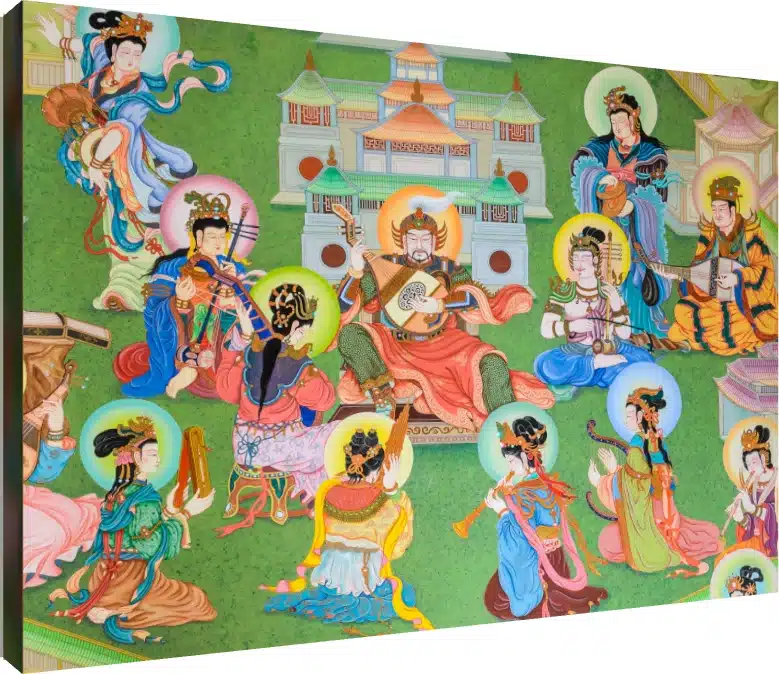
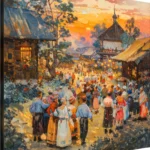
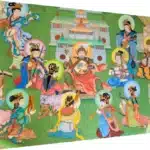
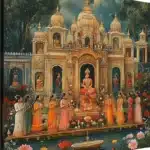
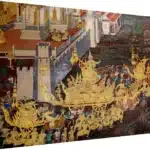

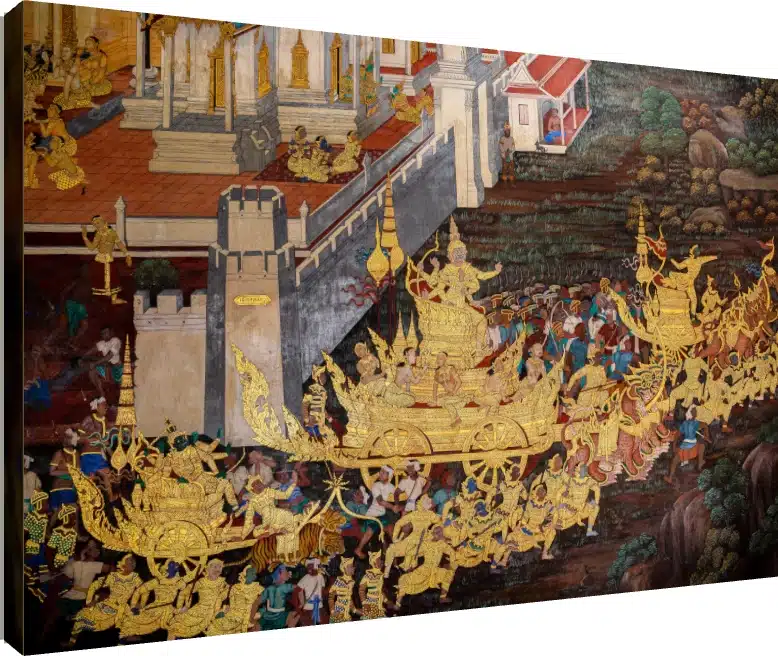
A Thai temple mural of a royal procession looks, at first glance, like art from somewhere far away: the figures are stylised in an unfamiliar way, the gold is applied differently, the composition obeys rules that Indian miniature painting does not. And then you notice a monkey general, a demon king with a many-tiered crown, a prince in exile — and realise you already know this story. You have known it your whole life.
This is the Ramakien, Thailand’s national epic and its retelling of the Ramayana. For an Indian viewer it is a strange and rewarding experience: your own epic, rendered in a visual language that developed a thousand kilometres away over several centuries. This piece looks at where that tradition comes from, what changed in the journey, and how to read and display an artwork drawn from it.
How the Ramayana became the Ramakien
The Ramayana is one of the most widely travelled stories in human history. It moved out of India along trade and pilgrimage routes and took root across Southeast Asia, acquiring a local name and local emphases wherever it landed: the Ramakien in Thailand, the Reamker in Cambodia, the Hikayat Seri Rama in the Malay world, the Kakawin Ramayana in Java, Phra Lak Phra Ram in Laos, the Yama Zatdaw in Myanmar.
These are not translations. They are independent literary traditions that happen to share a source, in the same way that the Tulsidas Ramcharitmanas is not a translation of Valmiki. Characters are renamed, episodes are expanded or dropped, and the moral weight shifts. The Thai version was given its definitive literary form under King Rama I, founder of the Chakri dynasty, whose regnal name is itself a reference to the epic’s hero.
What changed along the way
- The names are Thai. Rama becomes Phra Ram. Most strikingly, Ravana becomes Thotsakan — a name derived from the Sanskrit for “ten-necked”, preserving the ten-headed demon king of the original in Thai form.
- Hanuman is a different character. This is the change Indian readers notice most. The Hanuman of Indian tradition is celibate, devotional and defined by his service to Rama. The Ramakien’s Hanuman keeps the loyalty and the extraordinary powers but is far more worldly — mischievous, amorous, a trickster as much as a devotee. He is also given more narrative room, often functioning as the epic’s most engaging figure rather than a supporting one.
- It is a performance tradition as much as a text. The Ramakien lives in khon masked dance, in theatre and in music, not only in literature and painting. Much of its visual vocabulary — the poses, the crowns, the gestures — comes from how the story is staged rather than how it was written.
None of this makes the Thai version a deviation to be corrected. It is one of several mature traditions, and seeing a familiar story told with different emphases is most of the pleasure of looking at this kind of art.
The murals at Wat Phra Kaew
The reference point for all Ramakien painting is the gallery that wraps around Wat Phra Kaew, the Temple of the Emerald Buddha, inside the Grand Palace complex in Bangkok. The main mural cycle runs to 178 sections, with a further 80 images of significant characters — around 258 painted scenes and figures in total, forming a continuous narrative you follow by walking.
They were first painted under Rama I and have been restored and repainted several times since, which is itself characteristic of the tradition: these are living religious and civic artworks maintained across generations, not museum objects preserved in their original state. Thai mural painting is executed on prepared wall surfaces in a climate that is hostile to pigment, so periodic renewal is part of the form.
How to read Thai mural art
The visual conventions are specific and consistent, and knowing them changes what you see.
- There is no linear perspective. Depth is conveyed by stacking — figures higher in the composition are further away, not larger or smaller according to distance. European perspective arrived in Thai painting late and was never fully adopted.
- Status is shown by size and position. Kings, gods and principal figures are drawn larger than attendants and placed centrally or above them. Scale is a statement about importance rather than about where someone is standing.
- Space is filled, not left empty. Gaps between figures are occupied by the kranok flame-and-vine motif, by foliage, or by stylised cloud forms. The horror of empty space is a defining feature, and it is why these murals reward close looking — there is detail in every square inch.
- Faces are types, not portraits. Divine and noble figures have serene, almost identical idealised features; demons and monkeys are rendered with far more individual expression. Character is communicated through crown, costume, skin colour and posture rather than facial likeness.
- Gold is structural. Gold is used to mark what matters — crowns, ornament, architectural detail — rather than spread as decoration.
Why a procession
Processions recur throughout the epic and throughout the murals, and there is a formal reason as well as a narrative one. The Ramakien contains armies marching, kings travelling in state, and the triumphant return of a ruler to his city — all of which are naturally horizontal. A procession also solves a compositional problem elegantly: it gives the painter a legitimate reason to arrange dozens of figures in a readable sequence across a long wall, each distinguished by rank, costume and mount. The format suits the medium, which is why temple galleries are full of them.
Living with a piece like this
Mural-derived artwork has a particular quality as decor: it is dense. That is a strength and a constraint.
- It rewards close viewing, so place it where people can get close. An entryway, a hallway, a dining-room wall, the wall beside a reading chair. On a large living-room wall viewed only from five metres, most of what makes the piece good is invisible.
- Buy the largest size you can accommodate. Detail is the point, and detail is the first thing lost when a dense composition is printed small. This is the opposite of the advice for a minimal abstract, where a small print can still read perfectly.
- Give it a quiet wall. A busy composition needs plain surroundings. Against patterned wallpaper or beside heavily carved furniture, it becomes visual noise.
- Choose the finish for texture. A gallery wrap on canvas suits the painted, slightly absorbent quality of real mural surfaces. Acrylic will give you more saturation and gloss, which looks striking but reads as more contemporary than the subject is.
One point on lighting: dense, mid-dark compositions need more light than people give them. In a dim hallway a mural-style piece will collapse into an indistinct mass of warm colour. Light it properly — ideally at around 30 degrees from vertical so the light rakes across it without glaring back at you — or choose a brighter wall.
Why it belongs in an Indian home
There is a reasonable case that this is one of the more interesting things you can hang in an Indian house. It is recognisably the Ramayana, so it carries the same weight as any depiction of the epic. But it arrives in an unfamiliar idiom, which means it does something that a conventional Ramayana painting cannot: it makes a familiar story visible again. Guests who would walk past a standard devotional print will stop at this one, and the conversation it starts — that the Ramayana belongs to half of Asia and came back changed — is a better one than most wall art generates.
If you are considering placement alongside other devotional or traditional art, our post on Vastu tips for printed products covers room-by-room considerations in more detail.
The short version
The Ramakien is the Ramayana after several centuries in Thailand: the same story, with Thotsakan in place of Ravana, a markedly more worldly Hanuman, and a visual language built on stacked depth, status-based scale, filled space and structural gold. Artwork in this tradition is dense and detailed, so hang it where people stand close, buy it bigger rather than smaller, give it a plain wall and light it properly.
This piece is available from around ₹691 as a gallery wrap, acrylic print, floater frame or photo frame, in Small, Medium and Large, with free delivery across India above ₹300. You can preview it on a wall before ordering in the gallery collection.