

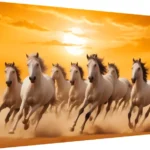
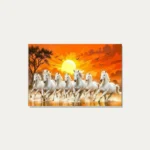
The seven-horse painting is probably the single most recognisable piece of auspicious art in India. It hangs in shop entrances, accountants’ offices, factory receptions and living rooms from Pune to Guwahati, and most people who own one can tell you it stands for success, speed and progress.
Far fewer can tell you why seven. Not five, not eight, not a dozen. The number is not arbitrary and it is not decorative. It comes from a specific place, it is considerably older than the Vastu advice attached to it, and the actual answer is stranger and better than the one usually given.
The horses belong to the sun
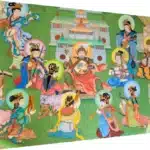
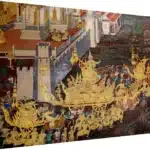
In Hindu cosmology, Surya — the sun — crosses the sky each day in a chariot, and that chariot is drawn by seven horses. The charioteer is Aruna, the light of dawn, who faces backwards toward Surya as he drives. This is not a minor piece of iconography. It is one of the oldest and most widely reproduced images in Indian religious art, and it is the source of the seven.
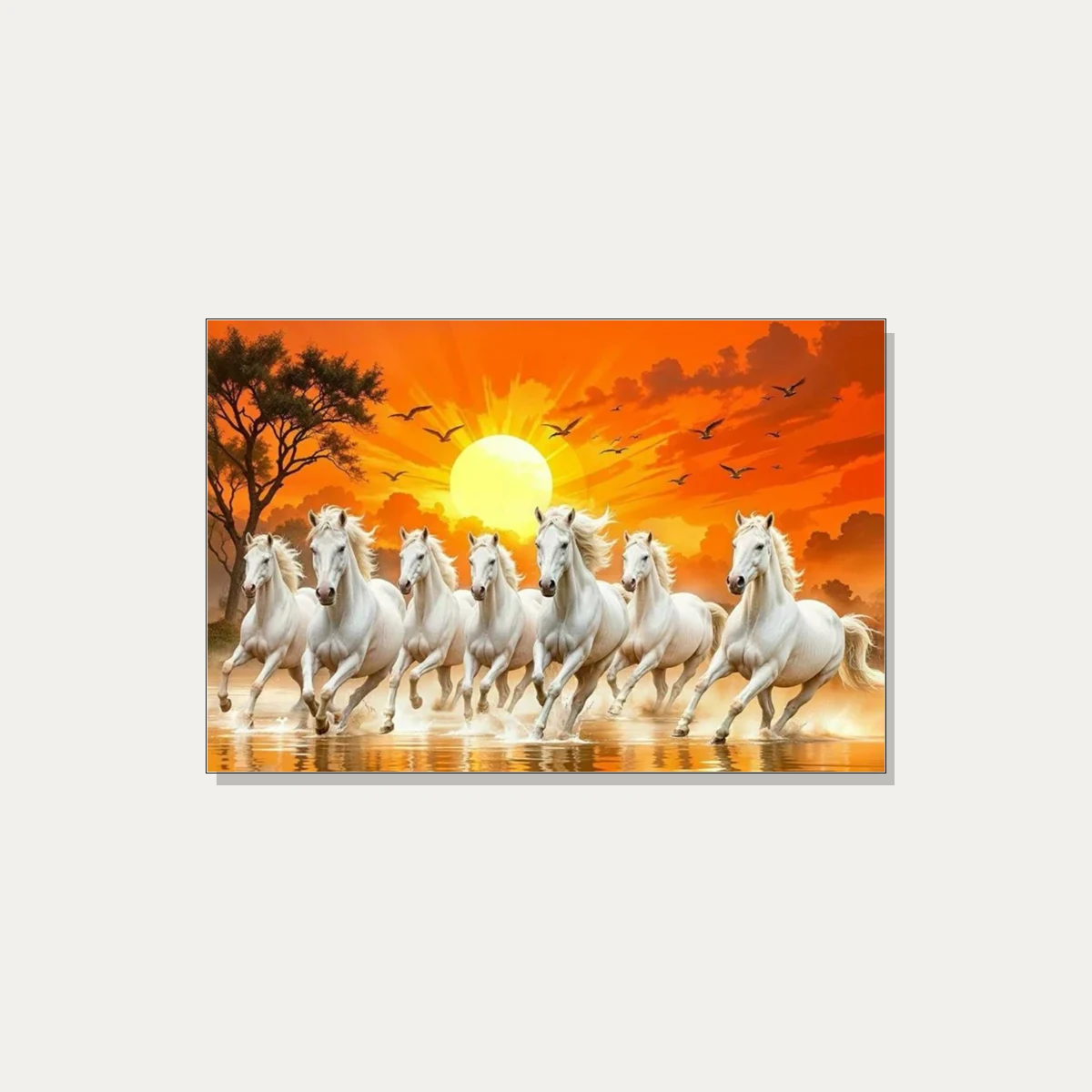
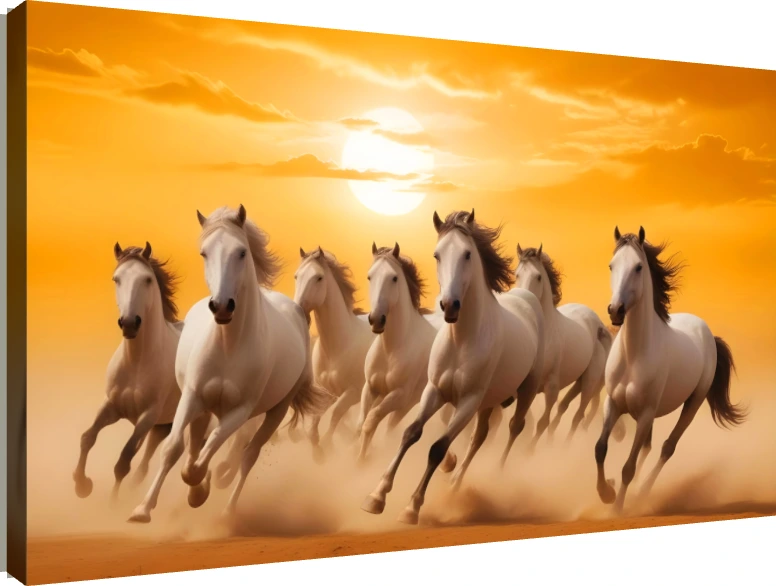
Which immediately explains something you may have noticed while shopping: nearly every seven-horse painting includes a sun. A sunrise, a sunset, a golden glow behind the herd. Sellers rarely explain why, and buyers often assume it is just a flattering light source. It is not. The sun is there because the horses are the sun’s horses. Remove it and you have a painting of seven horses; include it and you have a depiction of Surya’s chariot with the chariot left out.
The actual answer to “why seven”
Here is the part that almost never appears in articles about this painting, and it is the best fact in the whole subject.
The seven horses of Surya’s chariot are identified with the seven metres of Sanskrit prosody — the seven chhandas, the rhythmic structures in which Vedic verse is composed. They are named: Gayatri, Brihati, Ushnih, Jagati, Trishtubh, Anushtubh and Pankti.
Read that again, because the implication is remarkable. The sun is pulled across the sky by poetic metre. The force that moves light through the world is, in this scheme, sacred sound — structured rhythm. It is one of the most elegant ideas in Indian thought: cosmic motion and metrical verse are the same mechanism viewed from different angles.
Gayatri, the first of them, will be familiar for another reason — the Gayatri mantra, among the most widely recited verses in Hinduism, is composed in that metre and is addressed to the sun. The connection is not a coincidence; it is the same association running in both directions.
The chariot built in stone
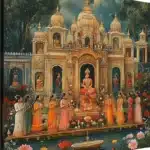
If you want to see the full idea rather than a painting of part of it, it exists as a building. The Konark Sun Temple in Odisha, constructed around 1250 CE under the Eastern Ganga king Narasimhadeva I, was designed as Surya’s chariot itself, rendered at architectural scale. It became a UNESCO World Heritage Site in 1984.
- Seven horses are carved drawing the structure — the same seven, in stone.
- Twenty-four wheels, each close to 3.7 metres across, line the base. They are read as twelve pairs for the twelve months of the Hindu calendar, each month divided into its two cycles, Shukla and Krishna.
- The wheels work as sundials. Their spokes and rims were cut so that shadow position gives the time — to the minute. The chariot of the sun tells the time by the sun.
That last detail is worth sitting with. The building is simultaneously a temple, a sculpture of a myth, a calendar and a working instrument. When you hang a seven-horse painting, this is the tradition you are drawing on — not a generic lucky-animal motif.
The other explanations you will encounter
Several alternative readings circulate, and it is worth being straight about which are traditional and which are later additions.
- The seven days of the week. A reasonable association rather than the origin. The seven-day week is itself built around the sun and the visible planetary bodies, so the overlap is genuine — but the Konark horses are named for metres, not days.
- The seven colours of visible light. Appealing, frequently repeated, and anachronistic. Dividing the spectrum into seven named colours is a seventeenth-century European convention, not an ancient Indian one. It is a modern reading laid over an older symbol, and worth enjoying as that rather than as history.
- The seven chakras. A later devotional mapping. Coherent within its own framework, but not the source of the number.
None of these is wrong to find meaningful. They are simply later layers, and the metres are the foundation underneath them.
How it became a symbol for business
The journey from Vedic cosmology to a painting above a shop counter is short once you separate the two components.
The horse, across most pre-modern cultures including India’s, carried a cluster of meanings: speed, stamina, power, and — importantly — status. Horses were expensive. They were military and aristocratic property. A horse was simultaneously a means of covering ground quickly and a visible marker of means.
The sun supplied the rest: energy, life, regularity, visibility, recognition. Something that rises reliably and is seen by everyone.
Put them together and you have a single image that means forward motion, endurance, standing and visibility — which is, more or less exactly, what anyone running a business wants. Vastu Shastra, which concerns itself with the arrangement of space and the imagery within it, adopted the motif on that basis, and it has stayed adopted. That is why this particular painting ended up in accountants’ offices rather than remaining in temples.
A confusion worth clearing up: Feng Shui uses eight
You will often see the claim that both Vastu Shastra and Feng Shui recommend seven running horses. This conflates two separate traditions, and the detail is easy to check.
Chinese practice does hold horses to be auspicious, but its canonical motif is the ba jun tu — the picture of eight steeds. These are the eight horses associated with King Mu of the Zhou dynasty and his journeys, and each carries its own named attribute: business luck, status, wealth, longevity, wisdom, endurance over distance, opportunity, and harmony. Eight is the significant number in that system, and other counts carry their own readings — some favourable, some specifically to be avoided.
So the seven-horse painting is an Indian symbol with an Indian origin. If you are buying one, you are drawing on Vastu Shastra and Surya’s chariot, not on Feng Shui. Anyone telling you both traditions converge on seven is repeating a marketing line rather than describing either system accurately.
The one detail that matters more than the rest
Across the traditional guidance, one point about these paintings recurs more consistently than any other: the horses should appear to be running forward — into the room, into the space, toward the viewer — rather than away or out through a doorway. The symbol is motion and arrival. A herd depicted galloping out of the frame and away from the room inverts the thing it is meant to convey.
It is also the easiest detail to get wrong at the point of purchase, because it depends on which wall you hang it on relative to the door — not on the painting itself. Worth deciding the wall before you decide the artwork. For directional guidance and room-by-room placement, our post on the Vastu meaning and placement of the 7 horse canvas print covers it, and our guide to Vastu tips for printed products sets it alongside other categories.
Reading a treatment: what to look for
Once you know where the symbol comes from, you can tell a considered rendering from a generic one. Four things are worth checking before you buy, and all of them follow directly from the iconography rather than from taste.
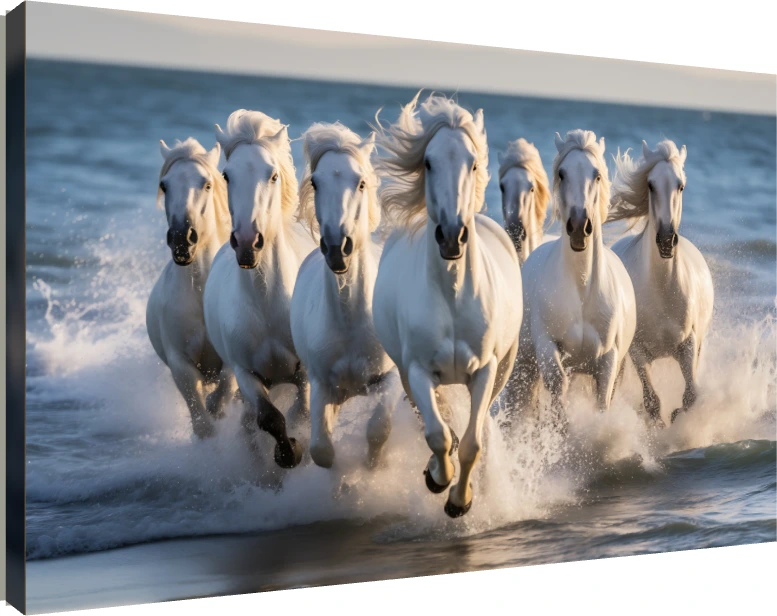
- Count them. This sounds facetious and is not. Herds are easy to render loosely, and a composition with a horse half out of frame or an eighth animal in the background has quietly stopped being the thing you wanted. If the number is your reason for buying, confirm it in the image rather than trusting the listing title.
- Find the sun. A treatment that includes the sun — rising, setting, or as a glow behind the herd — is depicting Surya’s chariot. One with no light source at all has kept the horses and dropped the reason there are seven of them. Both can be handsome; only one is complete.
- Check where the light comes from. The most iconographically apt treatments backlight the herd, so the horses are coming out of the light with manes and dust lit from behind. That is what it would look like if they were in fact drawing the sun. Front-lit horses with the sun off to one side are a landscape painting that happens to contain seven animals.
- Look at the direction of travel. As above, forward and into the frame rather than away. Also worth noticing whether they run level or uphill — ascending compositions read as climbing, which suits the symbol, while descending ones work against it.
One further detail for anyone who wants to look properly. The chariot in the full iconography has a driver — Aruna, the light of dawn, who faces backwards towards Surya as he drives. Almost no contemporary treatment includes him, and there is no reason it should; the herd alone has become the conventional shorthand. But knowing he is missing is a reminder that these paintings are an extract from a much larger image, in the way that a crown can stand in for a king.
What a painting can and cannot do
A word of honesty, since this subject attracts a lot of overclaiming.
Vastu Shastra is a traditional system concerned with space, orientation and imagery, and within that system this painting is held to support momentum, prosperity and recognition. Whether you treat that as efficacious, as cultural practice, or as neither is a personal matter, and no honest seller should tell you that hanging a canvas will raise your revenue.
What is defensible, and not small, is this: a deliberate daily reminder of an intention does affect how people behave. Putting an image of forward motion where you will see it every morning is a way of keeping an ambition visible. That is a real mechanism, it is the same reason people keep goals written down, and it does not require believing anything in particular about energy flow. Taken that way — as a two-thousand-year-old symbol of momentum, well made and well placed — the seven-horse painting earns its wall quite easily.
The short version
Seven, because Surya’s chariot is drawn by seven horses named for the seven metres of Sanskrit verse — Gayatri, Brihati, Ushnih, Jagati, Trishtubh, Anushtubh and Pankti. The sun in the painting is the chariot’s owner, not a lighting choice. The whole idea stands in stone at Konark, where twenty-four sundial wheels and seven carved horses make a temple into a chariot. Feng Shui’s horse motif uses eight, not seven, and is a different tradition entirely. And whichever version you buy, hang it so the horses run into the room.
The collection runs to twenty-seven treatments, available as gallery wraps, acrylic prints, floater frames and photo frames with free delivery across India above ₹300. You can preview any of them on a wall in the seven running horses collection, and our companion guide covers which of the twenty-seven to choose for your particular room.