
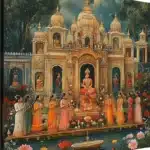


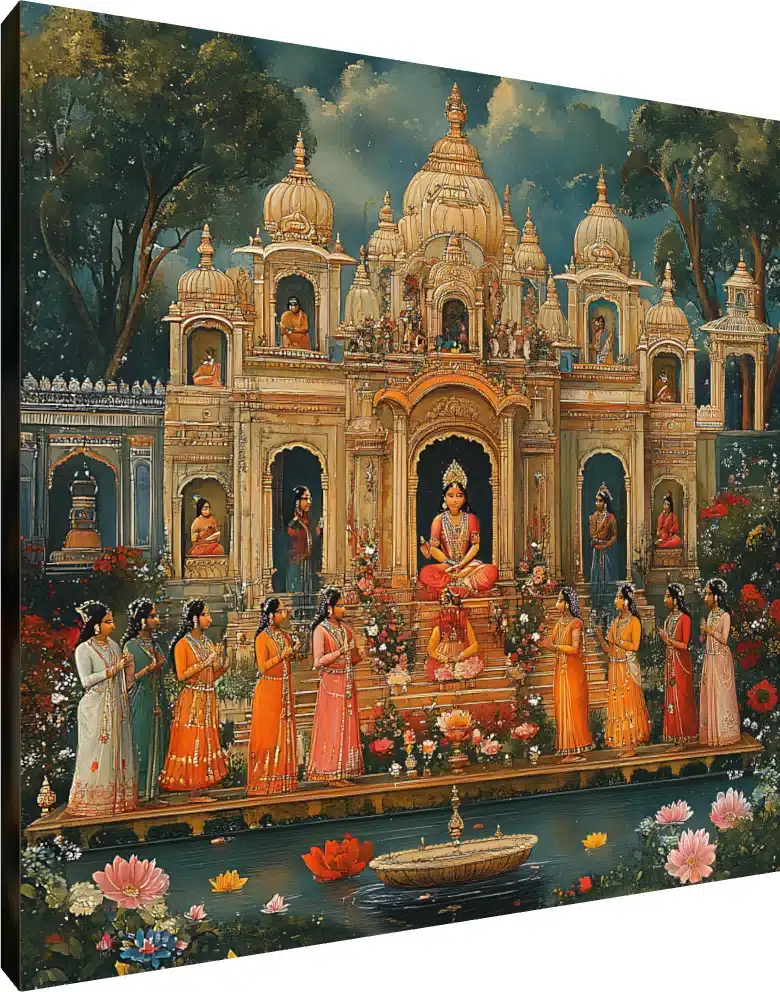
A temple rising above a pool of still water, lotuses on the surface, the whole structure doubled in its own reflection. It is one of the most frequently painted images in Indian art, and it is easy to assume the water is there because water is pretty. It is not. The pool is a real and specific piece of temple architecture, the lotus carries two thousand years of accumulated meaning, and the reflection is doing theological work as well as compositional work.
Knowing what each element is for changes how you look at a piece like this — and, practically, it changes where you should hang it.
The temple tank is architecture, not landscaping
Most substantial Indian temple complexes were built with a body of water as an integral component. It has different names in different regions — pushkarini or kalyani in the south, kund in the north, baoli or vav where the structure is a stepwell — but the function is consistent, and it is threefold.
- Ritual. Ablution before entering the sanctum is required in most traditions. The tank is where the worshipper becomes fit to approach the deity, which makes it part of the religious architecture rather than an amenity beside it.
- Practical water management. These were reservoirs, built in a climate of long dry seasons and concentrated monsoon rain. A temple tank was often the most reliable water source for the settlement around it, which is one reason temples became civic centres and not only religious ones.
- Climate. A large body of water cools the air moving across it. In a stone complex in a hot climate, the tank is also a piece of environmental engineering.
The engineering ambition involved can be extraordinary. Rani ki Vav at Patan in Gujarat — a stepwell inverted into the ground across several storeys, carved throughout with sculpture — was recognised as a UNESCO World Heritage Site in 2014. The Amrit Sarovar surrounding the Golden Temple at Amritsar gives the complex its name and its character. Hampi’s tanks, Thanjavur’s, and hundreds of less famous examples follow the same logic at different scales.
So when a painting puts a temple beside water, it is not inventing a picturesque setting. It is depicting how these buildings were actually conceived.
The lotus: why this particular flower
No plant carries more weight in Indian thought than the lotus, and the reason is a single observable fact about how it grows. It is rooted in mud at the bottom of a pond, it rises through murky water, and it opens at the surface entirely clean. Nothing adheres to it.
That became the governing metaphor for spiritual life across several traditions at once: existence in the world without being stained by it. From there the associations multiply.
- Divine birth and creation. Brahma is described as emerging from a lotus that rises from Vishnu’s navel — the universe unfolding like a flower opening.
- Lakshmi. The goddess of prosperity stands or sits upon a lotus and holds them; Padma and Kamala, both meaning lotus, are among her names. This is why lotus imagery is considered auspicious in a home rather than merely decorative.
- Buddhist usage. The lotus carries into Buddhism almost unchanged, as a symbol of enlightenment and purity of mind, and appears throughout Buddhist art across Asia.
- Architecture and posture. The lotus is built into the physical fabric of temples — lotus medallions on ceilings, the padmapitha or lotus pedestal beneath sculptures — and into practice, in padmasana, the lotus posture.
It is also, formally, India’s national flower. Few symbols manage to be simultaneously religious, architectural, botanical and civic.
What the reflection is doing
A temple doubled in still water is a composition with two readings, and both are worth knowing.
Compositionally, a reflection gives the painter near-perfect horizontal symmetry and a strong central axis. Symmetry reads as calm and order — it is the same instinct that makes formal gardens restful. It also doubles the subject without repeating it, since a reflection is always softer, slightly broken, less certain than the thing reflected.
Interpretively, that uncertainty is the point. A reflection is an image of a thing rather than the thing — present, recognisable, and not quite graspable. Indian philosophical writing returns repeatedly to the relationship between an object and its appearance, and a temple existing both solidly in stone and provisionally on water is a neat visual statement of it. You do not need to read it that way to enjoy the picture, but it explains why the motif has lasted.
Reading the architecture itself
Once you can name the parts of a temple, a painting of one becomes considerably more interesting, because the building tells you where in India you are.
- The garbhagriha is the sanctum — the small, dark, windowless chamber housing the deity. It is deliberately modest in size and deliberately unlit. The entire structure exists to shelter it.
- The mandapa is the pillared hall in front of the sanctum, where worshippers gather. In larger complexes there may be several in sequence.
- The tower above the sanctum is where regional style shows most clearly. In the northern Nagara tradition it is a shikhara: a curvilinear spire with a smooth, beehive-like profile. In the southern Dravida tradition it is a vimana: a stepped pyramid built in distinct receding tiers.
- The gopuram is the monumental gateway tower of South Indian temples, set in the enclosure wall. In many famous southern complexes the gopurams are considerably taller than the tower over the sanctum — the gateway outgrew the shrine.
So a painting with a smooth curving spire and no gateway tower is depicting a northern temple; one with stepped tiers and a towering gateway is southern. Painters generally render these conventions accurately, which means the architecture in a temple scene is usually a reliable regional signal rather than invented decoration.
There is one more thing worth knowing, because it explains the sense of weight these buildings carry in paintings. The progression through a temple is designed as a movement from bright, open and public to dark, small and private — courtyard, hall, antechamber, sanctum. A depiction that places the viewer outside, across water, puts you at the very start of that sequence, looking in. The distance is part of the subject.
The lotus reappears in the fabric of the building as well as in the pool: as carved medallions on hall ceilings, and as the padmapitha or lotus pedestal on which an image is placed. The flower in the water and the flower carved in stone are the same symbol, used twice.
Where a piece like this belongs
This is a calm, symmetrical, low-drama subject, which makes it unusually versatile — and it suits rooms where a bold abstract would be wrong.
- Bedroom. Genuinely well suited, which is rare for a detailed figurative subject. The symmetry and the still water give it a settled quality, and there is no face looking out of the frame.
- Prayer room or puja space. The obvious placement. Both the temple and the lotus are auspicious subjects, and the scale options mean it can work in a small alcove.
- Living room. Works as an anchor piece, particularly in a room with wooden furniture and warm tones, which the stone and golden-hour light in these scenes tend to complement.
- Entryway. A water-and-temple scene as a first impression reads as calm and considered rather than assertive.
Hang it level, and mean it
One practical point specific to reflection compositions: symmetry is unforgiving. A piece with a strong horizontal waterline and a central vertical axis will look visibly wrong if it is hung even slightly crooked, in a way that an asymmetric abstract would not. Use a spirit level — the one on your phone is adequate — and centre it properly on the wall rather than by eye. The waterline should also sit level with the horizon of the room: avoid hanging it where a nearby shelf or window ledge creates a competing near-horizontal line a few centimetres off parallel.
Choosing the finish
Water is the deciding factor here, and it pushes in an interesting direction.
| Finish | Effect on this subject |
|---|---|
| Acrylic | Gloss genuinely helps painted water. A reflective surface over a reflective subject gives the pool a wet luminosity that matte media cannot reproduce. Strongest choice if the wall is not facing a window. |
| Gallery wrap | Matte and textured, closer to a painting on canvas. Suits the stone and architecture well, slightly flattens the water. The safe choice in a bright room. |
| Floater frame | The frame edge reinforces the formality and symmetry of the composition. Good for a prayer room or a formal living room. |
| Photo frame | Works well here, because a conventional frame suits a traditional subject and the symmetry benefits from a defined border. |
If the intended wall is in a humid room, choose acrylic regardless of the aesthetic argument — stretched canvas can slacken on its frame over time in sustained humidity, and acrylic is a sealed surface that wipes clean.
If you follow Vastu
Water imagery is one of the subjects Vastu guidance addresses most specifically, with the north and north-east generally treated as the appropriate directions for it, and lotus imagery regarded as auspicious across placements. How strictly you apply this is personal, and nothing in the practical advice above depends on it. Our post on Vastu tips for printed products goes through placement by room and product type if it is a factor for you.
The short version
The pool in a temple painting is real architecture — ritual bathing, water storage and cooling, all at once. The lotus is there because it grows through mud and opens clean, which made it the oldest available metaphor for living in the world without being marked by it. The reflection supplies symmetry and calm. Together they make one of the few detailed figurative subjects that works in a bedroom. Choose acrylic if you want the water to look wet, hang it dead level because the symmetry will expose any error, and give it warm light.
This piece is available from around ₹581 as a gallery wrap, acrylic print, floater frame or photo frame, in Small, Medium and Large, with free delivery across India above ₹300. You can preview it on a wall before ordering in the gallery collection.