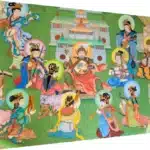




Musicians appear constantly in Buddhist mural painting, and it is easy to read them as incidental — court entertainers, a decorative border, atmosphere around a more important central scene. They are none of those things. The musicians are a specific class of being with a specific job, they have been painted continuously for roughly two thousand years, and the tradition begins in Maharashtra.
Who the musicians actually are
Indian cosmology has a populated middle ground between gods and humans, and much of it is musical. Three categories recur in art, all shared between Hindu and Buddhist traditions.
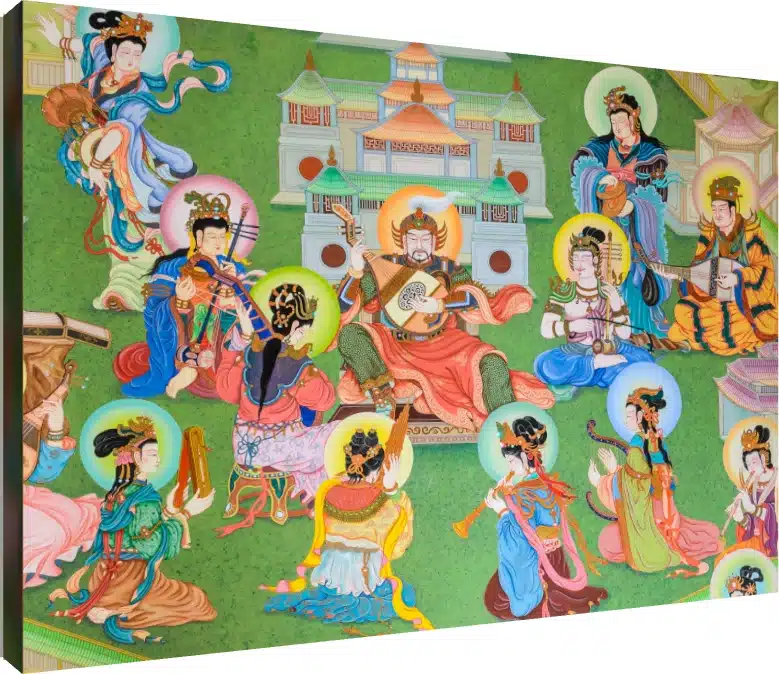
- Gandharvas are the celestial musicians proper — male figures whose function is to make music in the heavens. They are attendants and performers rather than objects of worship.
- Apsaras are celestial dancers, usually depicted in motion, often paired with gandharvas so that the music has something to accompany.
- Kinnaras and their female counterparts, kinnaris, are half-human and half-bird, and are specifically associated with music and devoted love. They become extremely prominent in Southeast Asian Buddhist art — if you see a musician with a bird’s legs or tail in a Thai or Burmese mural, that is a kinnara.
What unites them is that they are not the subject of the painting. They are the evidence of the subject. Their presence tells you that something of cosmic significance is taking place, in the way that a fanfare tells you a monarch has entered.
Why music, and not something else
Sound occupies a privileged position in Indian religious thought. The syllable, the chant and the recited text are not descriptions of sacred things but sacred things in themselves — which is why mantra is efficacious rather than merely expressive. Music inherits that status. It is an offering in the same category as flowers, lamps and incense, and it is a standard component of worship rather than an accompaniment to it.
In Buddhist narrative art this becomes a visual convention. The great events of the Buddha’s life — his birth, his enlightenment, his teaching, his passing — are shown attended by celestial music. Painting the musicians is a way of marking the moment as cosmically witnessed, without having to depict the heavens directly. A mural of musicians is therefore usually telling you that you are looking at the edges of a major scene.
The instruments are a historical record
One genuinely interesting thing about this body of art: because painters depicted real instruments, these murals are a source for the history of South Asian music. Lutes and early forms of the veena, transverse flutes, barrel and hourglass drums, hand cymbals and conches all appear. Instruments that no longer exist in playable form survive as paintings, and changes in their construction can be tracked across centuries of murals. A decorative panel of musicians is also, incidentally, an archive.
It starts at Ajanta
The Ajanta caves in Maharashtra are where this painting tradition is first visible at scale. Cut into a rock face above a river bend and worked on across several centuries from around the 2nd century BCE, the caves hold the most important surviving body of early Indian painting, and they were recognised as a UNESCO World Heritage Site in 1983. Among the narrative panels and the famous bodhisattva figures are musicians and dancers — and the conventions established there travelled further than almost any other Indian artistic export.
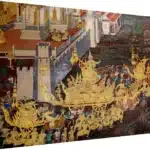
For anyone in Maharashtra this is worth saying plainly: the visual language behind a Thai or Tibetan temple mural of celestial musicians can be traced back to a rock face a few hours from Pune. The route ran along the Buddhist pilgrimage and trade networks — north-west into Central Asia, east to the cave temples at Dunhuang in China, and south-east into the mural traditions of Thailand, Myanmar, Cambodia and Sri Lanka. Each region reworked the figures in its own idiom, which is why a kinnara in Bangkok and a flying musician at Dunhuang look nothing alike and are nonetheless relatives.
The palette, and why it looks the way it does
Traditional mural painting has a distinctive narrow palette, and it is tempting to read that as a stylistic preference. It was mostly a materials constraint. Painters used what could be ground from earth and mineral sources locally and would survive on a plastered wall for generations.
- Reds, yellows and browns came from ochres — iron-bearing earths, abundant almost everywhere and extremely stable. This is why the palette of early mural painting across Asia is dominated by warm earth tones.
- White came from lime or chalk, and black from lampblack, the soot of burnt oil.
- Greens came from green earths and copper minerals.
- Blue was the expensive problem. True blue required lapis lazuli, mined in a small number of places and transported enormous distances. It was reserved for what mattered most. When you see a confident blue in a traditional mural, you are looking at a deliberate and costly decision.
This has a direct consequence for anyone buying this kind of work as a print, and it runs opposite to intuition. A narrow earth-tone palette is harder to reproduce well than a bright one, not easier. The interest in these paintings lives in subtle transitions between closely related browns, ochres and reds — exactly the tonal range where cheap printing produces banding, muddiness or a colour cast. Bright saturated colour is forgiving by comparison. It is the reason wider-gamut printing earns its place on traditional subjects: the fidelity shows up in skin tones and shadow, not in the loud colours.
One honest complication worth knowing: surviving murals have aged. Pigments have darkened, lime has yellowed, surfaces have been cleaned and repainted over centuries. The colours we now associate with “traditional” mural art are partly the colours of age. A contemporary artwork in this tradition is making a choice about which version to represent — the murals as they look now, or as they may have looked when freshly painted, which would have been considerably brighter.
How to read the composition
- Figures float. Celestial beings are shown airborne, often with no ground line at all. Trailing scarves and ribbons indicate movement — they are the convention for flight, not a costume detail.
- Poses are drawn from dance. The bent knees, tilted hips and angled heads come from classical dance vocabulary. These figures are posed according to a codified system of gesture, not sketched from life.
- Depth is stacked. Figures higher in the frame are further back. Linear perspective is absent, as it is throughout Asian mural painting.
- The eye is meant to travel. Mural panels are designed to be read along their length as you walk, so a composition of this kind usually has no single focal point. That is deliberate, and it affects where the piece works on a wall.
Living with a piece like this
A musicians panel has a specific quality as decor: it is rhythmic and even rather than dramatic. That makes it well suited to some rooms and poorly suited to others.
- Rooms where people gather. A dining room, a living room, a lounge. The subject is sociable and the absence of a single focal point means it does not compete with conversation.
- Hallways, particularly. A composition designed to be read by walking past it belongs on a wall you walk past. This is the most natural placement and the most under-used.
- A music room or practice space. Obvious, and genuinely appropriate rather than merely thematic.
- Less suited as a lone living-room anchor. An anchor piece needs a focal point to arrange furniture around, and an even rhythmic panel does not supply one. It works far better on a long wall, or as part of a pair.
Buy it as large as the wall sensibly allows. Mural-derived work is dense with detail — faces, instruments, ornament — and detail is the first casualty of printing small. If you are choosing between a larger gallery wrap and a smaller premium finish, the larger piece will serve this subject better.
Finish and light
A gallery wrap on canvas is the most sympathetic choice, because the matte, slightly absorbent surface is closest to how real mural painting on prepared plaster behaves. Acrylic will give you more saturation and a gloss that reads as contemporary — striking, but further from the source. A floater frame suits the piece if you want it to present formally.
Light it generously. Traditional mural palettes are built on earth pigments — ochres, reds, browns, with white and black — and in dim light they collapse into an undifferentiated warm mass. Aim light at roughly 30 degrees from vertical so it rakes across the surface rather than bouncing straight back, and keep the bulb temperature warm, which suits earth tones. A wall with no light at all is the wrong wall for this subject, however good the piece.
The short version
The musicians are gandharvas, apsaras and kinnaras — celestial beings whose music marks an event as cosmically significant. The tradition is first visible at Ajanta in Maharashtra and travelled from there across Asia, which is why Thai, Tibetan and Chinese versions are all recognisably related. As decor the work is rhythmic rather than dramatic: it belongs on long walls and in hallways and sociable rooms, wants to be bought large because detail is the point, suits a matte canvas finish, and needs real light to work at all.
This piece is available from around ₹691 as a gallery wrap, acrylic print, floater frame or photo frame, in Small, Medium and Large, with free delivery across India above ₹300. You can preview it on a wall before ordering in the gallery collection.