









“Photo frame” sounds like one product. It is at least five, and they have little in common beyond holding a photograph. A border frame starts at ₹99. An acrylic print starts at ₹453. A backlit LED panel runs into the thousands. They suit different rooms, different photographs and different reasons for buying, and the most common mistake is not picking the wrong size — it is picking the wrong type entirely.
This guide sorts them out. Each type gets a section explaining what it physically is, the sizes it comes in, and when it is the right answer. At the end there is a short decision tree, and throughout there are links to the detailed guide for each type if you already know which one you want.
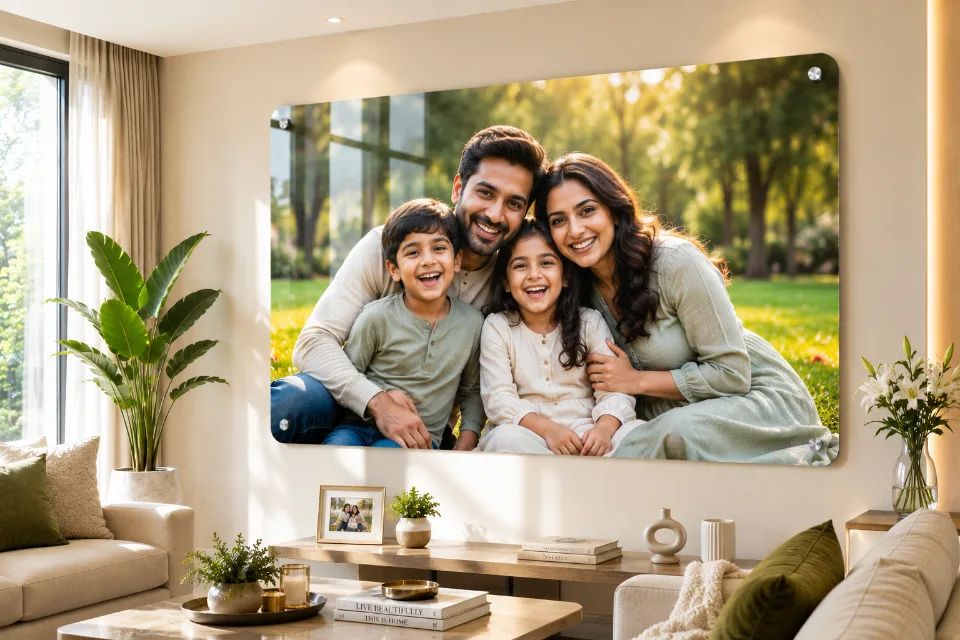
The five types at a glance
| Type | What it is | From | Best for |
|---|---|---|---|
| Border frame | Conventional moulding around a print, with an optional mat | ₹99 | Traditional interiors, gallery walls, tight budgets |
| Acrylic | Print behind a clear acrylic panel; glossy, frameless look | ₹453 | Modern interiors, vivid photographs |
| Canvas floater | Canvas set inside a frame with a deliberate gap | Varies | Art-like presentation, formal rooms |
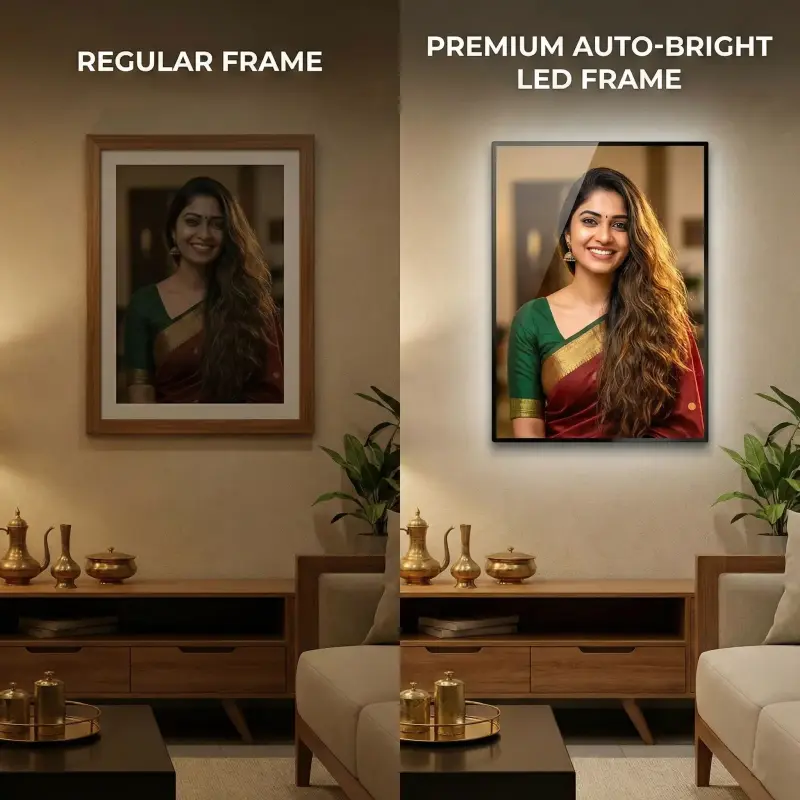
| LED frame | Print with an integrated backlight | Varies | Dim walls, evening rooms, gifts |
| Table top | Standing frame for a desk or shelf | Varies | Desks, bedsides, offices, no wall drilling |
Border frames: the default, and the widest size range
A border frame is what most people picture: a print, a moulding around it, and optionally a mat — the flat margin between the photograph and the frame edge. It is the cheapest option at ₹99 and it comes in more sizes than any other type, from 4 × 6 in up to 24 × 36 in.
Choose it when:
- Your room leans traditional. Wooden furniture, carved detail, classical interiors — a visible moulding belongs; a frameless glossy panel fights it.
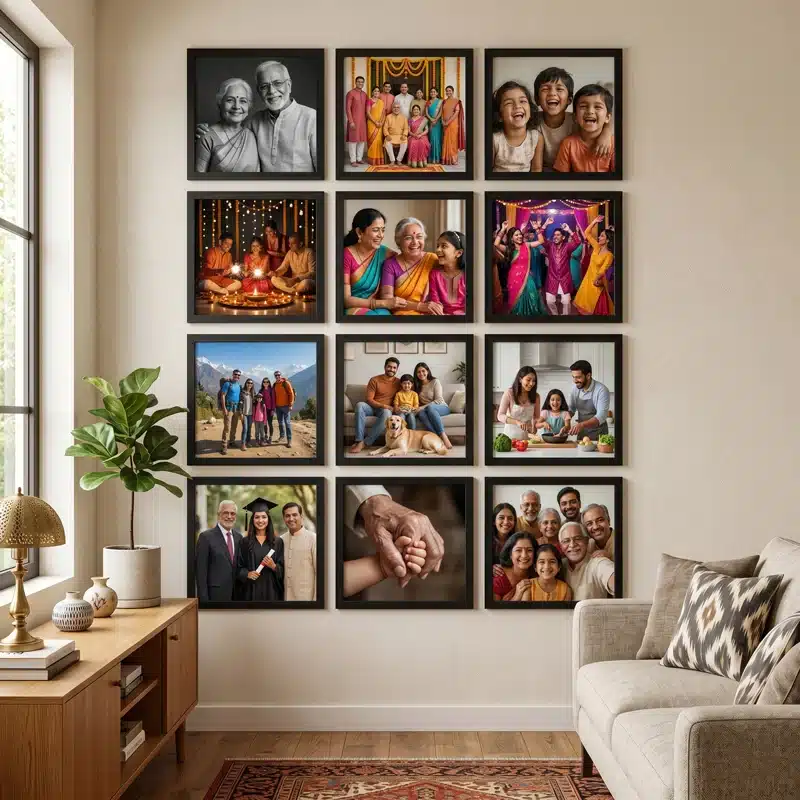
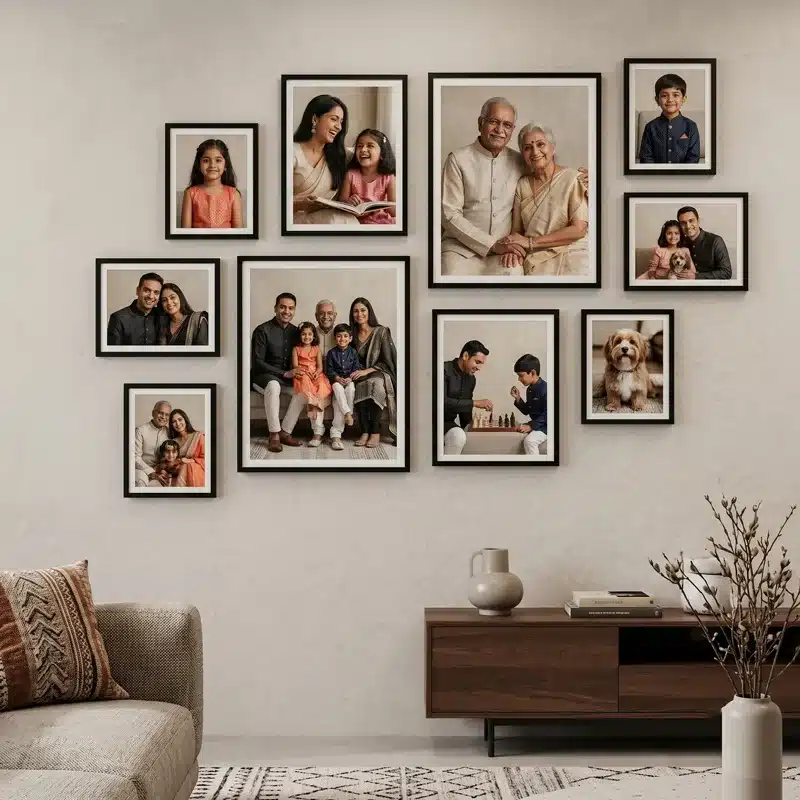
- You are hanging several frames together. A gallery wall needs the visual consistency a moulding provides. Frameless acrylic panels in a group tend to read as unresolved.
- The photograph is quiet. Portraits, candid shots, older photographs. Gloss flatters saturated colour; it does little for a soft family photo and can make an older scan look harsh.
- Budget matters. At ₹99 entry this is the only type where you can frame a dozen photographs without the cost becoming the project.
The outer-size trap
This catches more first-time buyers than anything else on this page, so it is worth stating clearly. The size you order is the print size, not the size of the object that arrives. The moulding adds to every side. Add a mat and it adds more. A 12 × 18 in border frame with a mat can easily occupy 18 × 24 in of wall.
Two consequences. First, if you are fitting a frame into a measured gap — an alcove, the space between two windows, a shelf with a cabinet above — measure against the outer dimensions, not the print size. Second, when you apply the two-thirds rule for sizing above furniture, the outer size is what counts visually, so a bordered frame achieves the same presence as a slightly larger frameless one.
When a mat earns its place
A mat is not just decoration. It does two useful things: it gives the eye a rest between the wall and the image, which makes a photograph look more deliberate, and it lets a small print hold a larger wall position without being enlarged. A 8 × 10 in photograph with a generous mat can command the space of a 16 × 20 in frame while keeping the image at a size its resolution comfortably supports — which is genuinely useful if your source photo is limited.
Skip the mat when you are grouping many frames closely, where mats eat the available wall, or when the photograph runs edge to edge by design.
Acrylic: gloss, depth and the glare question
An acrylic frame puts your photograph behind a clear acrylic panel, giving a glossy, frameless, contemporary object. Sizes run from 8 × 10 in to 24 × 36 in. Gloss deepens saturated colour and adds a sense of depth that matte media cannot reproduce, which makes it the strongest choice for vivid photographs — travel, landscapes, anything with strong colour.
The trade-off is reflection. A glossy panel on a wall facing a window or directly opposite a light will show you the room at certain hours. If the intended wall faces a window, a border frame or canvas is the more practical choice however much you prefer the acrylic look.
Acrylic is also considerably heavier than canvas at the same dimensions, which matters if you are relying on adhesive hooks rather than a wall fixing.
If acrylic is where you are heading, two further reads: our complete guide to acrylic photo frames covers the material in depth, and our piece on UV versus 12-colour printing for family photos on acrylic explains why the printing technology matters as much as the panel — particularly for skin tones.
Canvas floater frames: for when it should read as art
A floater frame holds a stretched canvas inside a frame with a deliberate gap, so the canvas appears to float rather than sit flush. It is the most gallery-like presentation available and the right answer when you want a photograph to be looked at as a picture rather than as a memento.
Canvas has one genuine technical advantage worth knowing: its woven texture is forgiving. It hides softness, grain and mild compression that a glossy surface would expose. If your source photograph is older, scanned, or simply not very large, canvas will flatter it where acrylic will interrogate it.
It has effectively no glare, which makes it the safe option for bright rooms. Our guide to canvas floater frames covers the construction and the sizing.
LED frames: when the wall has no light
An LED frame carries its own backlight, so the photograph is lit from behind rather than depending on the room. That makes it the answer to a specific problem rather than a general upgrade: a bedroom you mostly see after dark, a hallway with one overhead bulb, a corner that never catches daylight. In a bright, well-lit room an LED frame is paying for an effect you will only notice for part of the day.
Two practical constraints. It needs a power point within cable reach — which rules out a lot of walls. And because backlighting magnifies every flaw in a photograph, it is the least forgiving option for a limited source image.
Our guide to LED photo frames covers the light tones, running cost and all the available sizes, and there is a separate piece on giving one as a gift, which is what a lot of these are bought for.
Table top frames: no drilling required
Standing frames for a desk, shelf, bedside or office cabin, available from 6 × 8 in up to 12 × 18 in. The obvious advantages are that they need no wall fixing and can be moved, which makes them the sensible default for rented homes and for office desks you may not occupy forever.
The thing to get right is scale. A table top frame is viewed from well under a metre, and people routinely order these too large. At arm’s length a 12 × 18 in frame dominates a desk and leaves nowhere to work. For a desk or bedside, 6 × 8 in or 8 × 10 in is usually the right answer; reserve the larger sizes for a wide shelf or a credenza where there is room around them.
And if you want several at once
Multi-frame bundles are sold as pre-planned sets with a layout worked out, at a bundle saving against buying the frames individually. They solve the hardest part of a gallery wall, which is not hanging it but deciding how many frames of what sizes in what arrangement.
Our guide to choosing the right photo frame bundle compares the sets, and how to plan and hang a gallery wall covers the measuring method, the paper template trick and the fixings that actually hold in Indian concrete and brick.
The decision tree
Five questions, in this order, will land you on a type.
- Wall or surface? If it is going on a desk, shelf or bedside, you want a table top frame and the rest of this list is irrelevant.
- Does the wall have light? If the answer is genuinely no — a dim hallway, a windowless landing — and there is a socket nearby, an LED frame is the only type that solves it.
- Does the wall face a window or a light? If yes, rule out acrylic. Glare will undo it. Border frame or canvas.
- One photograph or several? Several means a bundle, and almost certainly border frames for consistency.
- Traditional or modern room? Traditional takes a border frame or a floater; modern takes acrylic or a frameless treatment.
One more question worth adding if your photograph is older, scanned, or came off a phone years ago: how forgiving does the finish need to be? Canvas is the most forgiving, border frames with a mat are next, and glossy acrylic and LED are the least. Choosing a forgiving finish is often a better use of money than paying to upscale a weak file.
Before you order: check the shape, not just the size
A photograph fills a frame without cropping only when the two share a shape. Phone photos are typically 3:4, which fits sizes like 6 × 8 in and 18 × 24 in cleanly. Camera photos are typically 2:3, which fits 4 × 6, 8 × 12, 12 × 18, 20 × 30 and 24 × 36 in. Mismatch the two and something gets cut — and in a group photograph, what gets cut is usually somebody’s shoulder.
This, plus whether your photograph has enough resolution for the size you want, is worth five minutes before you order rather than after. Our guide to whether your photo will print sharp covers the resolution maths, the cropping problem and how viewing distance changes the answer. The size guide lists every size in inches and centimetres with the shape each one suits.
Mistakes worth avoiding
- Measuring the gap, ordering the print size. The moulding and mat add to every side. Check outer dimensions for a tight space.
- Acrylic opposite a window. The single most regretted frame decision.
- A table top frame sized like a wall frame. At arm’s length, smaller is better.
- Mixing frameless and bordered in one group. Pick one register for a gallery wall.
- Buying an LED frame for a bright room. You are paying for a backlight you will rarely see.
- Upscaling a weak photo instead of choosing canvas. Texture hides what software cannot fix.
All five types, with previews and current pricing, are on the photo frames page. Border frames start at ₹99 and acrylic from ₹453, with pan-India delivery and free shipping on eligible orders.