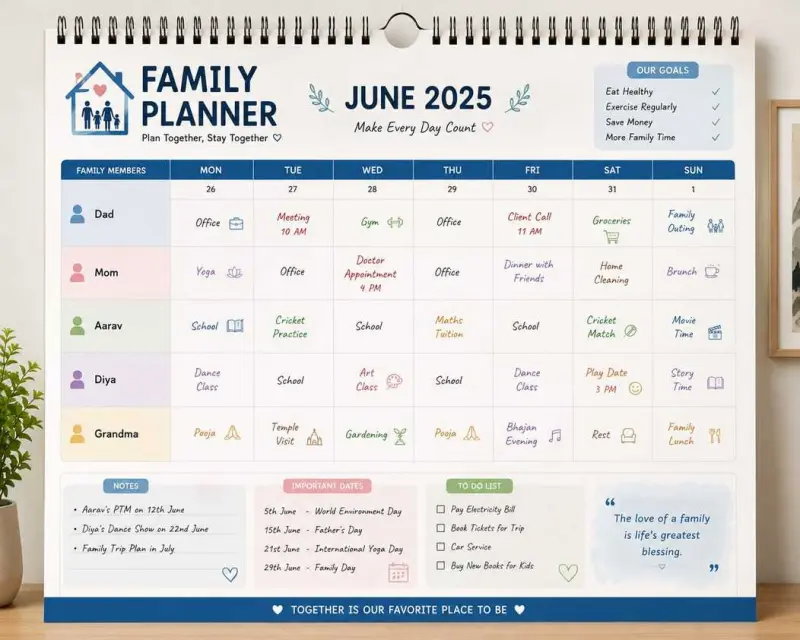








Most corporate gifts have a short life. A branded diary gets replaced by a phone. A sweet box is finished in a week. A desk toy is admired once and then migrates to a drawer.
A calendar is different, and the difference is simple arithmetic. If your branded calendar ends up on a client’s wall or desk, your company name sits in their eyeline for roughly 250 working days. There are very few marketing items that buy that much sustained attention for a few hundred rupees.
This guide covers how to plan, specify and order corporate photo calendars sensibly: which formats survive in an office, how to handle logo placement without ruining the design, the financial-year question, bulk data import, and the timeline you actually need.
Why calendars still work as business gifts
The case for a calendar rests on three things that most promotional items lack.
Duration. A calendar is in use for twelve months by definition. Nothing else in the standard corporate gifting catalogue has a guaranteed year-long lifespan.
Placement. Calendars occupy wall and desk space, which is to say prime visual real estate in an office. A pen lives in a drawer. A calendar lives at eye level.
Utility without obligation. A calendar is genuinely useful, which means the recipient keeps it for their own reasons rather than out of politeness. That is a meaningfully different relationship from a gift that gets kept because throwing it away would feel rude.
The catch is that a badly designed corporate calendar fails all three. If it is visually unpleasant, it does not get hung, and then none of the above applies. The design question is not decoration; it is whether the gift works at all.
Which formats work in an office
Not every calendar format suits a business context. Here are the ones that do, with starting prices.
| Format | From | Where it lands |
|---|---|---|
| Corporate Calendar (13 pages) | ₹399 | The default; built for branding |
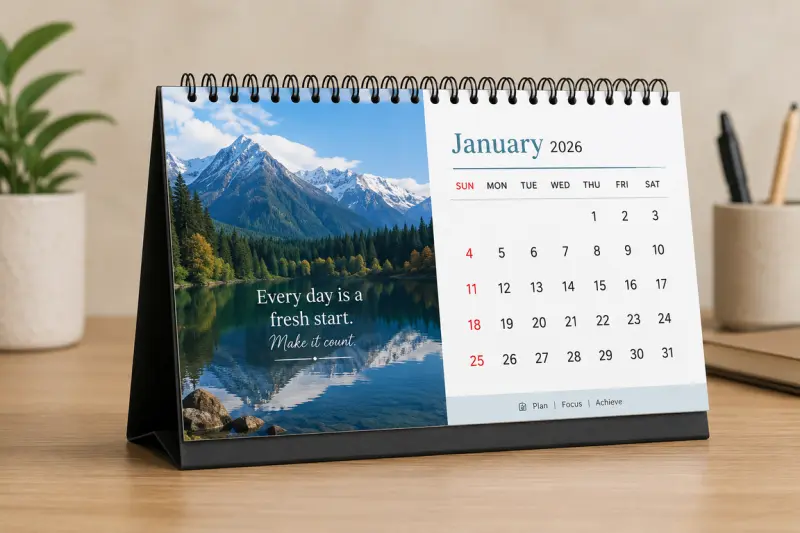
| Desk Calendar (13 pages) | ₹399 | Individual desks, highest personal visibility |
| Wall Calendar (13 pages) | ₹399 | Shared areas, meeting rooms, shop floors |
| Flip Calendar (13 pages) | ₹699 | Reception desks, senior client gifts |
| Poster Calendar (A2/A1) | ₹249 | Planning walls, operations rooms |
| Acrylic Calendar (13 pages) | ₹599 | Premium recipients, small quantities |
| Single Page | ₹99 | High-volume handouts, events, trade shows |
A useful way to decide is to split your recipient list by relationship value rather than treating everyone identically.
- Top accounts and key partners. Flip or acrylic. Low quantity, high perceived value, and the binding or material does the talking.
- General client base. Desk or corporate calendars. The volume tier where most of your budget goes.
- Staff. Wall or desk. Staff calendars can be warmer and less formal than client ones, and often should be.
- Events and trade shows. Single page at ₹99. Printed in quantity, handed out freely, no agonising over cost per unit.
- Operations and planning teams. A2 or A1 poster calendars, which are a working tool rather than a gift.
The financial year question
This is the single most overlooked decision in Indian corporate calendar planning, and it is worth getting right.
Indian businesses run on an April-to-March financial year. Budgets, targets, appraisals, quarterly reviews and tax planning all follow that cycle. Yet almost every corporate calendar distributed in the country runs January to December, because that is what calendars have always done.
A custom year option lets you choose any starting month, so an April-to-March calendar is straightforward to produce. The advantages are practical:
- Quarters on the calendar match quarters in the business. Q1 is April to June on the wall and in the review deck.
- It arrives in a quieter window. March and early April are far less crowded for printing than December.
- It stands out. In an office where every other calendar started in January, yours is the one that matches how people actually plan.
Selectable years run from 2026 to 2030, so you can plan a cycle in advance rather than scrambling each year.
One caveat: if your recipients are consumers rather than businesses, stay with January. The financial-year calendar is a B2B instrument.
Branding without wrecking the design
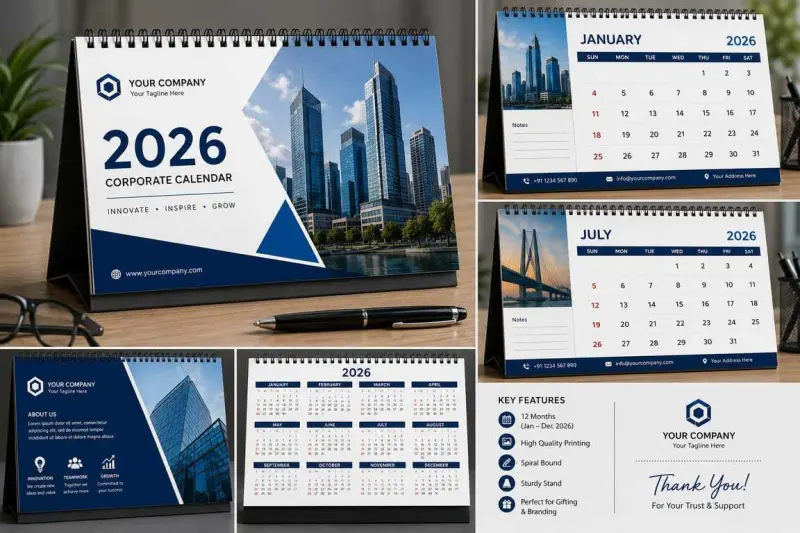
The most common corporate calendar mistake is treating every page as advertising space. A logo on the cover, a logo on each month, a tagline across the bottom, contact details in the footer, and a QR code in the corner. The result is something nobody wants on their wall, which defeats the entire purpose.
A calendar earns its place by being pleasant to look at. The branding works precisely because the object is welcome. Some principles worth holding to:
One clear brand presence per page
A logo at consistent size and position on each page is sufficient. Repetition does the work; size does not. A small, well-placed mark that appears thirteen times registers more positively than a large one that irritates.
Full contact details once, not everywhere
Put the address, phone number and website on the cover or the final page. Anyone who wants to contact you will find them. Repeating them monthly makes the calendar feel like a flyer.
Use your real brand typeface
Over 100 Google Fonts are available and custom fonts can be uploaded. If your brand uses a specific typeface, upload it. A calendar set in a default font looks generic next to your other materials, and the inconsistency is noticeable to anyone who sees both.
Choose photographs that are not products
Twelve pages of product shots is a catalogue, not a gift. Photographs of your people, your premises, the places you work, or imagery connected to your industry all read better. A manufacturer might show craft and process. A travel business might show destinations. The photography should be something the recipient would plausibly want on their wall if your logo were removed. That is the test.
Company dates and bulk data
Corporate calendars support logo placement, company events and Excel import for bulk data. That last feature is the one that makes large or data-heavy calendars practical.
Rather than entering dates one at a time, you can prepare a spreadsheet and import it. Things worth loading:
- Company holidays. Your actual holiday list, which rarely matches a generic national one.
- Financial milestones. Quarter ends, audit windows, filing deadlines, board meetings.
- Staff birthdays and work anniversaries, for internal calendars.
- Industry events. Trade shows, conferences and exhibition dates relevant to your sector.
- Customer-facing dates. Sale periods, product launches, service windows.
Holiday packs cover Indian holidays plus US, UK, religious, school and custom sets. For a company with offices in more than one country, a combined pack avoids the awkwardness of a calendar that only marks one location’s holidays.
A calendar carrying your real operating dates stops being a gift and becomes a reference object. Those are the ones that survive the January clear-out.
Materials and what they signal
Specification carries meaning in a corporate context, whether or not the recipient could name the paper weight.
Paper
Options run 170 GSM to 300 GSM in matte, gloss and photo paper. For corporate work the weight decision is straightforward: heavier feels better in the hand, and a gift that feels flimsy undermines the message. Lower weights make sense for high-volume single-page handouts where unit cost dominates.
Matte versus gloss matters more than people expect. Offices have overhead fluorescent or LED lighting, which glares badly off gloss stock. A gloss wall calendar in a typical office is partly unreadable depending on where you stand. Matte also accepts pen, and a calendar people write on is a calendar they keep. For corporate use, matte is usually correct.
Binding and stands
Spiral, wire, hard-bound and soft-bound are all available, with wood and metal stands for desk formats.
Wire binding on a flip calendar reads as considered and stationery-grade. Hard binding signals premium and suits a small run for senior recipients. Soft binding is lighter and cheaper to post, which matters when you are couriering several hundred units. For desk stands, metal tends to suit corporate environments while wood reads warmer and works better for creative or hospitality businesses.
Acrylic and canvas for the short list
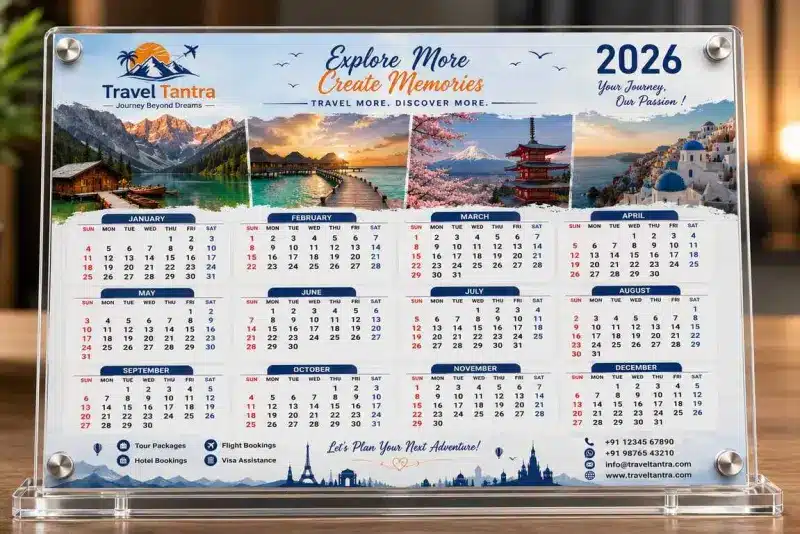
Acrylic calendars start at ₹599 and canvas at ₹1,999. Neither makes sense for a mass distribution, and both make sense for a list of twenty names where the gift is part of a relationship rather than a campaign.
Canvas is printed on 400 GSM cotton canvas as a single page, which means it survives the year it covers. For a long-standing client, a canvas piece that stays on the wall after December is a different kind of gift from something that gets recycled.
Print quality and why it matters more here
A personal calendar with a slightly soft photograph is forgivable. A client gift with visible banding in a sky or muddy skin tones in a team photograph reflects on your company.
Calendars are printed with archival pigment inks using a 12-colour process. The practical benefit over conventional 4-colour printing shows up in exactly the places corporate calendars tend to struggle: gradients, corporate brand colours that sit outside a standard four-ink gamut, and skin tones in team photographs. If you want the technical background, we have covered the difference between multi-colour and 4-colour printing separately.
Brand colour is worth flagging early. Some corporate colours, particularly vivid oranges, deep blues and certain greens, sit at the edge of what print can reproduce. If exact colour matching matters, raise it before the run rather than after, and approve a physical proof.
Image preparation for business calendars
Corporate photography has its own failure modes, most of them to do with where the files came from.
- Do not pull images from your website. Web images are compressed and sized for screens. They will not hold up at print size. Go back to the originals from the photographer.
- Avoid logo files in the wrong format. A logo lifted from a web page will have soft edges in print. Use the original vector or a high-resolution version.
- Check who is in the team photographs. People leave. A calendar distributed in January featuring someone who resigned in November is awkward for everyone.
- Get permission for staff photographs, particularly for calendars going to external recipients.
- Beware heavy stock-photo reliance. Generic stock imagery signals that no effort was made, which is worse than no calendar.
Automated checks flag blur, low resolution, noise, faces cut off, orientation problems and pixelation before printing, which catches technical faults. They cannot catch an out-of-date team photo or a logo in the wrong colour, so those remain your job.
Preview modes include flat, book, wall, desk, room, office and 3D views. The office view is genuinely useful for a corporate order, because it shows whether your design reads at the distance people will actually see it from.
Ordering in bulk
Bulk ordering is available for corporate and event calendars. Volume pricing and proof approval are handled directly rather than through standard checkout, so contact the team with your quantity and specification.
Information worth having ready when you get in touch:
- Quantity, split by format if you are running tiers.
- Start month, January or April or something else.
- Format, paper weight, finish and binding.
- Whether you need a physical proof before the full run.
- Your delivery date, and whether units ship to one address or many.
- Your dates spreadsheet, ready for import.
Always approve a proof for a corporate run. A spelling error in a client name, a logo in the wrong colour or a wrong public holiday is cheap to fix before printing and expensive afterwards. The extra day in the schedule is the best insurance available.
Timeline: when to start
Corporate calendar projects run late more often than any other print job, because the design is usually waiting on someone’s approval while the deadline does not move.
For a January calendar, a workable schedule looks roughly like this:
- September: decide format, quantity and budget. Brief photography if new images are needed.
- October: gather photographs, compile the dates spreadsheet, draft the design.
- Early November: internal approval and proof.
- Mid November: place the production order.
- Early December: delivery, leaving time to distribute before the holidays.
For an April financial-year calendar, shift everything back by three months, with the production order placed in mid-February. You will be working in a far less congested window.
Calendars are made in India with free pan-India delivery and secure packaging, shipped flat or rolled depending on format. If you are distributing to multiple offices, confirm the split when you place the order rather than afterwards.
Frequently asked questions
What is the minimum order for corporate calendars?
No fixed minimum is published for bulk corporate orders. Pricing and proof approval are arranged directly, so get in touch with your quantity and specification for a quote.
Can we have a calendar that starts in April?
Yes. The custom year option supports any starting month, which makes an April-to-March financial year calendar straightforward.
Can we add our own company holidays and events?
Yes. Company events can be added, and an Excel import handles bulk data so you are not entering dates individually. Custom holiday packs sit alongside the standard Indian, US, UK, religious and school sets.
Which format is best for client gifting?
Desk calendars for general clients, because they sit in the recipient’s line of sight all day. Flip or acrylic calendars for a smaller list of senior contacts where the object itself should feel premium.
Matte or gloss for an office calendar?
Matte. Office overhead lighting glares off gloss stock, and matte accepts pen so people can write on it. A calendar that gets written on is a calendar that stays up.
Can we match our exact brand colour?
12-colour printing reproduces a wider range than standard 4-colour, which helps considerably. Some highly saturated brand colours still sit at the limits of what print can achieve, so raise colour matching early and approve a physical proof.
In short
A corporate calendar works when it is something people would keep even without the logo. Restrained branding, photography worth looking at, matte paper, your real operating dates loaded into the grid, and a start month that matches how your recipients actually plan.
Tier your list rather than buying one format for everyone, build in time for a proof, and start three months before you need delivery.
You can review formats and specifications at PrintPosters.in photo calendars, or read our full breakdown of every calendar format, material and price before deciding.