





A photo calendar is one of the few gifts that stays in daily use for an entire year. A framed print gets hung once and then fades into the background. A calendar gets touched, written on, flipped over and looked at every single morning. That is twelve months of someone seeing your photographs, not twelve seconds.
But “photo calendar” covers a surprising range of products. A ₹99 single-page sheet and a ₹1,999 canvas calendar are both photo calendars, and they serve completely different purposes. This guide walks through every format available at PrintPosters.in, what each one is actually good for, the materials involved, and how to choose without overspending or under-buying.
The ten formats at a glance
Before going into detail, here is the full range with page counts and starting prices. Prices shown are starting prices; the final cost depends on size, paper and binding.
| Format | Pages | From | Best for |
|---|---|---|---|
| Single Page | 1 | ₹99 | Budget gifting, bulk handouts |
| Poster Calendar | 1 | ₹249 | Year-at-a-glance planning |
| Magnetic Fridge | 12 | ₹349 | Kitchens, daily family use |
| Wall Calendar | 13 | ₹399 | Living rooms, the classic choice |
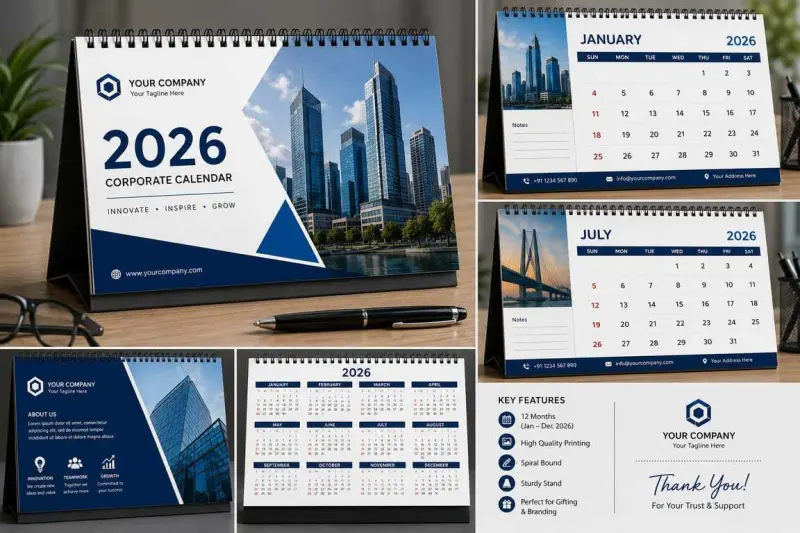
| Desk Calendar | 13 | ₹399 | Work desks, study tables |
| Corporate Calendar | 13 | ₹399 | Client and staff gifting |
| Acrylic Calendar | 13 | ₹599 | Premium desk pieces |
| Family Planner | 13 | ₹599 | Households juggling schedules |
| Flip Calendar | 13 | ₹699 | Reception desks, premium gifts |
| Canvas Calendar | 1 | ₹1,999 | A keepsake that outlives the year |
Notice the page counts. Most formats are 13 pages, not 12. That extra page is the cover, which carries your headline photograph and is the one people see most often while the calendar sits unopened on a shelf or in its packaging. It is worth choosing that image carefully.
Wall calendars: the default for a reason
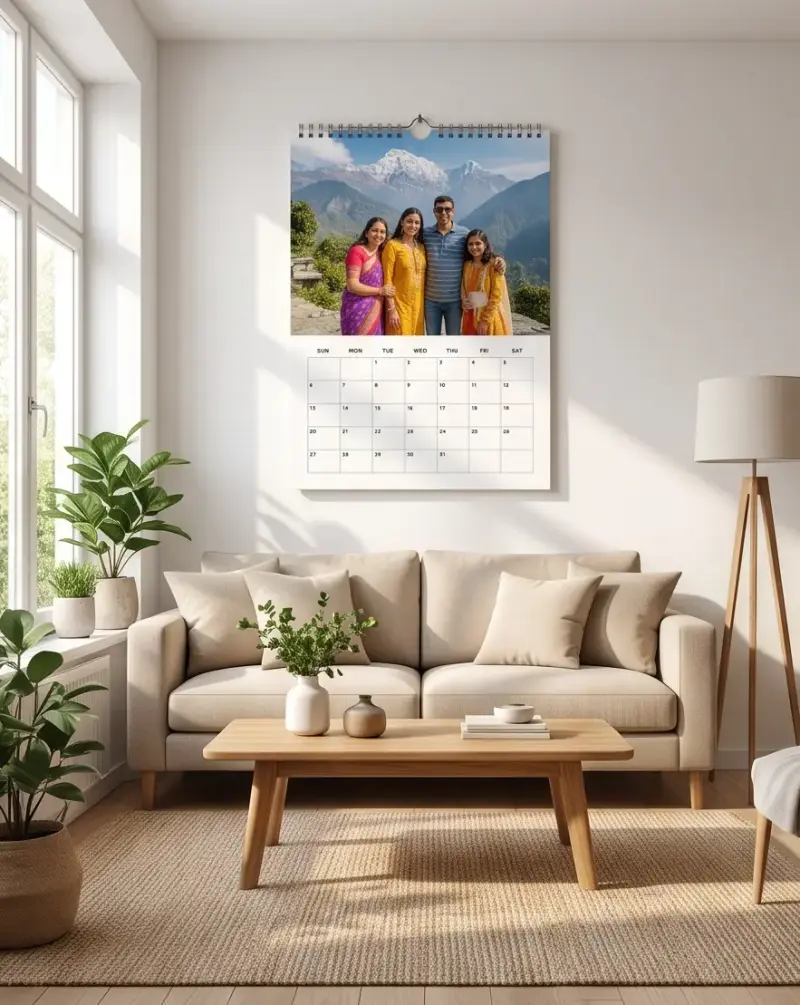
The wall calendar is what most people picture when they think of a photo calendar: a photograph on the upper portion, a month grid below, hung from a hook or a spiral binding. Thirteen pages, starting at ₹399.
It works because of where it lives. A wall calendar hangs at eye level in a kitchen, hallway or living room, which means the photograph gets seen dozens of times a day by everyone in the house. If you are printing family photographs, holiday pictures or images of children growing up, this is the format that delivers the most viewing time per rupee.
Things to consider before ordering a wall calendar:
- Wall space above the hook. A wall calendar needs clear space both for the photo panel and the grid below it. Measure before choosing a size.
- Landscape versus portrait photographs. Most wall calendar layouts favour landscape images. Portrait photographs can work but often get cropped harder than you expect.
- Who writes on it. If the calendar is going to be used as an actual planner rather than decoration, make sure the date boxes are large enough to write in.
Desk calendars: small space, constant presence
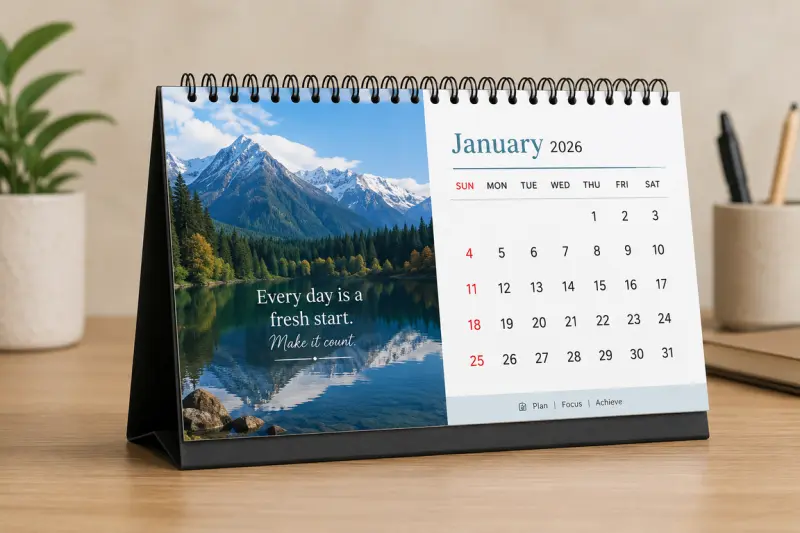
A desk calendar sits within arm’s reach for eight hours a day. Also 13 pages and also starting at ₹399, it trades the wall calendar’s size for proximity.
This proximity changes which photographs work. On a wall calendar viewed from three metres away, a wide landscape shot reads beautifully. On a desk calendar viewed from forty centimetres, close-up portraits and detailed images work far better, because you can actually see the detail. A sweeping mountain vista shrunk to desk size often loses everything that made it worth printing.
Desk calendars are also the format most often given as a corporate gift, because they sit in the recipient’s line of sight at work. If a logo is going on the piece, this is where it gets seen.
Poster and single-page calendars: the whole year at once
These two are the odd ones out, because they are one page rather than thirteen.
The Poster Calendar starts at ₹249 and is available in A2 or A1. All twelve months are laid out on a single large sheet with a photograph, usually at the top. The appeal is planning: you can see the entire year without flipping anything. Project managers, teachers, event planners and anyone who thinks in quarters rather than weeks tend to prefer this.
The Single Page Calendar starts at ₹99, the cheapest option in the range. It is the practical choice when you need volume: wedding favours, school handouts, festival giveaways, shop counters. At that price you can print a hundred and not think too hard about it.
The trade-off with both is photograph count. A thirteen-page calendar shows thirteen images. A single-page calendar shows one. If the point of the gift is to display a collection of memories, single-page is the wrong format no matter how good the price is.
Magnetic fridge calendars
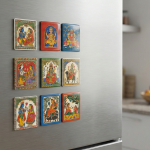
Twelve pages, starting at ₹349, designed to stick to a refrigerator door. This is the only format in the range with twelve pages rather than thirteen, because there is no separate cover page to display.
The fridge door is arguably the highest-traffic surface in an Indian home. People check it while making tea, packing lunches and unloading groceries. For a calendar that is genuinely used rather than admired, this format has a real argument. It pairs naturally with personalised fridge magnets if you want a coordinated set.
Family planners
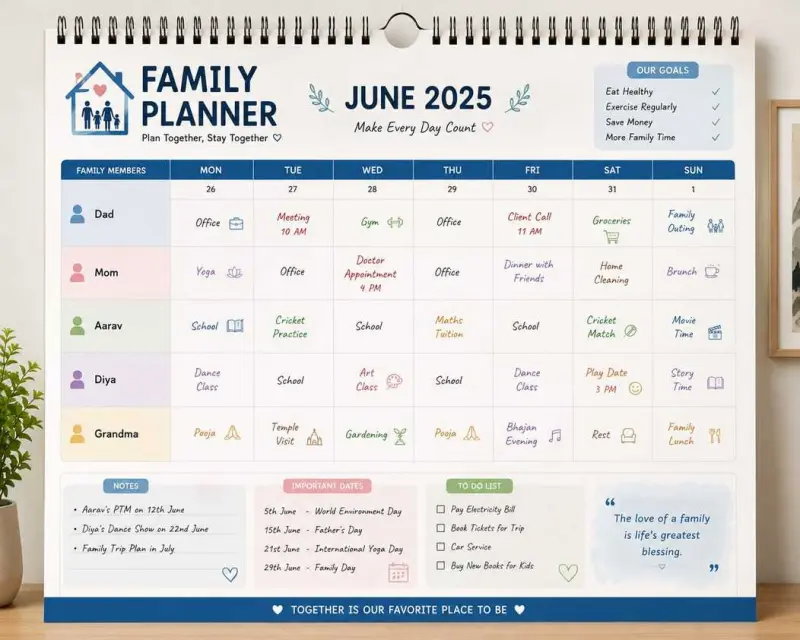
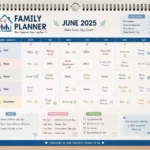
At ₹599 for 13 pages, the family planner is a wall calendar with a different grid. Instead of one box per day, each day is divided into columns, typically one per family member. Everyone’s commitments sit side by side.
This is a genuinely functional product rather than a decorative one. Households with school-age children, multiple working adults and overlapping tuition, practice and travel schedules get real value from being able to see the week at a glance. The photograph becomes secondary to the grid, which is worth knowing before you buy one expecting a showcase for your pictures.
Flip calendars
At ₹699, the flip calendar is wire-bound and designed to stand and flip over rather than hang. Thirteen pages.
The wire binding is the point. It lets pages lie flat and turn cleanly, and it gives the object a more finished, stationery-shop feel than a stapled or folded calendar. Reception desks, consulting rooms and client-facing offices tend to choose this format because it looks deliberate rather than promotional.
Acrylic calendars
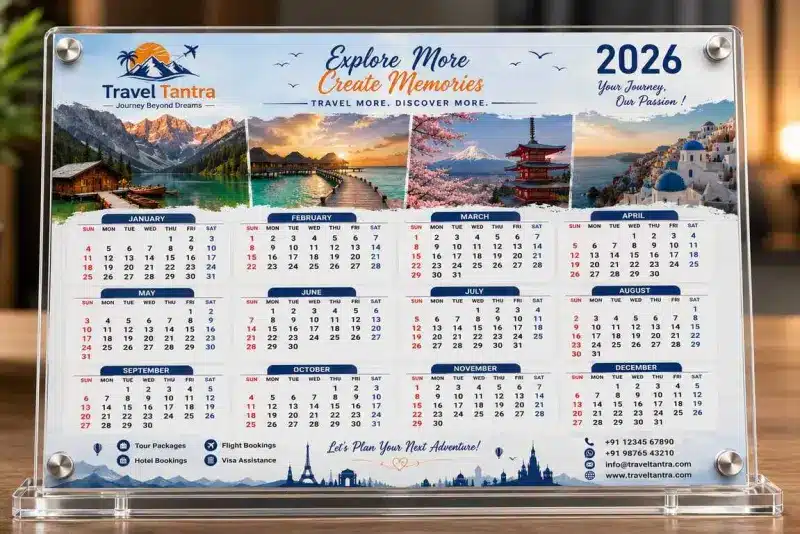
Printed on crystal-clear acrylic panels, starting at ₹599 for 13 pages. Acrylic behaves differently from paper: light passes into the panel and reflects off the printed surface, which gives photographs a depth and gloss that paper cannot reproduce.
If you have already seen an acrylic photo frame in person, you know the effect. Colours look more saturated and blacks look deeper than the same file printed on matte paper. It suits high-contrast, colour-rich photographs and flatters portraits.
Acrylic is also heavier and more rigid than paper, which makes it feel substantial as a gift. The trade-off is that it shows fingerprints, so it belongs on a desk rather than somewhere it will be handled constantly.
Canvas calendars
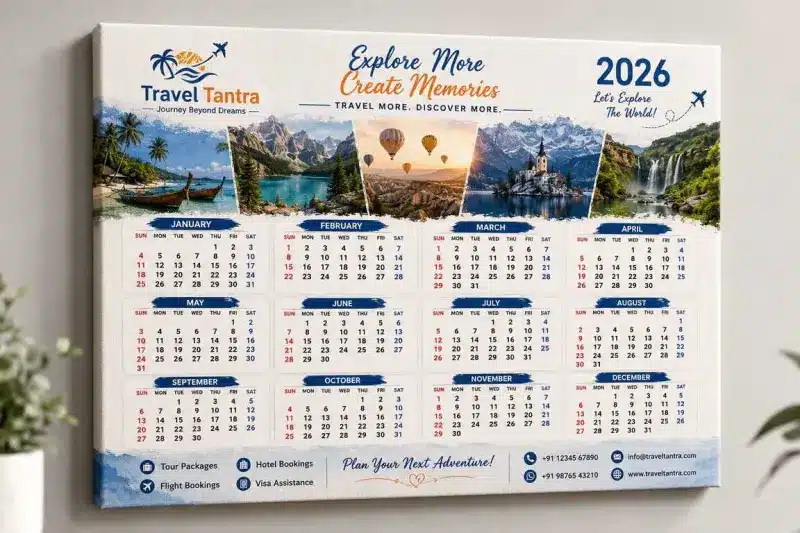
At ₹1,999 this is the most expensive option in the range, and it is a single page printed on 400 GSM cotton canvas.
The logic here is different from every other format. A paper calendar is disposable by design: when December ends, it goes in the recycling. A canvas calendar is built to survive the year it describes. People keep them, because the canvas and the photograph are worth keeping even when the dates are irrelevant. It becomes wall art that happens to have had a calendar grid on it.
If you want to understand why cotton canvas is used rather than a cheaper synthetic blend, the same material considerations apply as with any canvas print: fabric weight, weave texture and how the coating holds pigment ink.
Materials: paper, canvas and acrylic
Material affects both appearance and cost more than most buyers expect.
Paper weight and finish
Paper options run from 170 GSM to 300 GSM, in matte, gloss and photo paper finishes.
GSM is grams per square metre, a measure of weight and therefore of thickness and stiffness. For context, ordinary office paper is around 80 GSM. At 170 GSM a calendar page is noticeably more substantial than a printout but will still curl over a year on a wall. At 300 GSM it holds its shape, resists creasing and feels like a proper product.
Finish matters as much as weight:
- Matte diffuses light, so there is no glare from a window or ceiling light. It is the safest choice for a wall calendar, and it is far easier to write on with a pen.
- Gloss reflects light, which deepens colours and increases apparent contrast. It photographs well and looks punchy, but it catches reflections and resists ink from most pens.
- Photo paper sits between the two in character and is the closest to a traditional photographic print.
If anyone is going to write appointments on the calendar, choose matte. This single decision causes more post-purchase regret than any other.
Inks and colour
Calendars are printed with archival pigment inks using a 12-colour process. The practical difference between 12-colour and standard 4-colour printing shows up most in skin tones, subtle gradients like skies, and deep shadow detail. A four-ink process has to approximate those tones by mixing; additional inks reproduce them more directly. We have covered the difference between multi-colour and 4-colour printing in more depth separately.
Archival pigment inks also matter for a product that hangs in daylight for a year. Dye-based inks shift and fade under sustained light exposure; pigment inks hold their colour considerably longer.
Binding and stands
Binding options include spiral, wire, hard-bound and soft-bound, with wood and metal stands available for desk formats.
- Spiral is the familiar coil. Pages turn a full 360 degrees and lie flat. Durable and inexpensive.
- Wire is tighter and more refined than spiral, with a more finished appearance. Used on the flip calendar.
- Hard-bound gives a rigid cover and the most premium feel, suited to gifts where presentation matters.
- Soft-bound is lighter and cheaper, sensible for bulk orders being posted out.
For desk calendars, the stand changes the character of the object considerably. A wood stand reads warm and domestic; a metal stand reads clean and corporate. If the calendar is a client gift, match the stand to the recipient’s office rather than your own taste.
Customisation beyond the photographs
The photographs are the obvious part. The configuration options are where a calendar becomes genuinely personal.
Choosing your year, including custom start months
Years from 2026 to 2030 are selectable, and there is a custom year option that lets you pick any starting month.
That custom start is more useful than it sounds in India. A calendar beginning in April aligns with the financial year, which is what most businesses, accountants and school administrators actually plan against. A calendar beginning in June aligns with many academic years. Buying a January-to-December calendar for an office that thinks in April-to-March quarters is a small mismatch that annoys people all year.
Holiday packs
Indian holiday packs are available, alongside US, UK, religious, school and custom packs. Given how much regional variation there is in which festivals are marked as holidays, the ability to load a relevant set rather than a generic one is worth using. A custom pack lets you add observances specific to your family, community or organisation.
Personal dates and events
Birthdays, anniversaries and recurring events can be added with icons. This is the feature that turns a calendar from a printed object into something a family actually relies on. Load every birthday in the extended family once, and nobody has an excuse for the rest of the year.
Typography
Over 100 Google Fonts are available, and you can upload a custom font. For businesses that means the calendar can carry the same typeface as the rest of your brand materials rather than a generic default.
Image quality: the part that decides everything
No printing process rescues a bad source file. A calendar page is large, and enlargement is unforgiving.
There are automated image checks that flag blur, low resolution, noise, faces cut off at the frame edge, wrong orientation and pixelation before the file goes to print. That catches most problems, but it is still worth understanding what to send:
- Use the original file, not a messaging-app copy. Photographs sent through WhatsApp are compressed heavily. A picture that looks fine on a phone screen can fall apart when enlarged to calendar size. Pull the original off the camera or phone gallery.
- Check the crop before you commit. Calendar panels have fixed proportions. If your subject is near the edge of the frame, something is getting cut.
- Avoid heavy digital zoom. Zoomed phone photographs are cropped and upscaled in-camera, which means less real detail than the file size suggests.
- Mind the light. Photographs shot in dim conditions carry noise that becomes very visible at print size.
Live preview modes include flat, book, wall, desk, room, office, mobile and 3D views, so you can see how the finished calendar will look in context before ordering rather than guessing from a flat thumbnail.
How to choose: a short decision path
If the range feels like too many options, work through these questions in order.
- Where will it live? Wall, desk, fridge or reception counter. This eliminates most of the range immediately.
- How many photographs do you want to show? One, or thirteen. Single-page and poster formats show one; everything else shows thirteen.
- Will anyone write on it? If yes, you need matte paper and reasonably large date boxes, which rules out acrylic and most gloss finishes.
- Is it a gift or a tool? Gifts justify acrylic, canvas and hard binding. Tools justify family planners and matte wall calendars.
- What year does the recipient think in? Calendar year or financial year. Set the start month accordingly.
Ordering, delivery and bulk
Calendars are made in India with free pan-India delivery, packed either flat or rolled depending on format, with secure packaging.
Bulk ordering is available for corporate and event calendars. Volume pricing and proof approval are handled directly rather than through the standard checkout, so get in touch if you are ordering quantity. For anything going to clients or staff, approving a physical or digital proof before the full run is always worth the extra day.
One timing note: calendars are seasonal, and the window between late November and early January is when every printer in the country is busiest. If you need calendars for January delivery, order in October or November. Leaving it to the last week of December limits your format choices and your proofing time.
Frequently asked questions
What is the cheapest photo calendar available?
The Single Page Calendar starts at ₹99. It shows one photograph with all twelve months on a single sheet, which makes it suited to bulk gifting rather than displaying a collection of images.
Why do most calendars have 13 pages instead of 12?
The thirteenth page is the cover. It carries a headline photograph and is what people see before the calendar is hung or opened. Magnetic fridge calendars are 12 pages because they have no separate cover.
Can I start my calendar in April for the financial year?
Yes. The custom year option lets you choose any starting month, so an April-to-March financial year calendar is straightforward to set up.
Which paper should I choose if we write on the calendar?
Matte, and at the higher end of the GSM range if the calendar will be handled often. Gloss finishes resist most pen inks and smudge easily.
How many photographs do I need for a 13-page calendar?
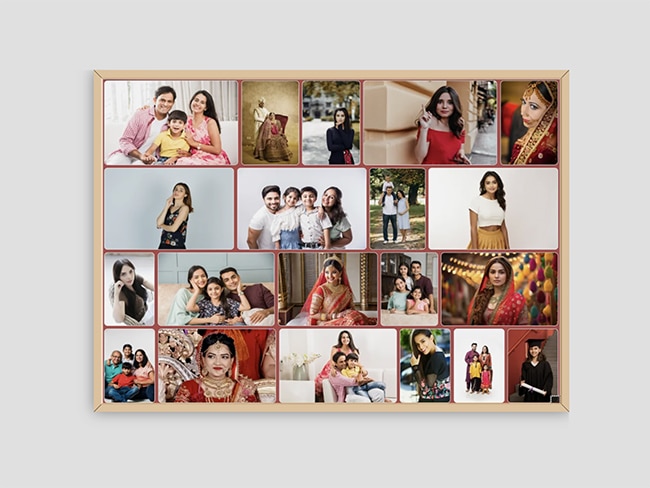
Thirteen as a minimum, one per month plus the cover. Photo uploads are unlimited, so collage layouts using several images per month are possible if you have more pictures than slots.
Will the colours fade over the year?
Calendars are printed with archival pigment inks, which hold colour far better than dye-based alternatives under sustained light. Hanging a calendar in direct, all-day sunlight will still shorten its life, as it would any print.
In short
The format decision follows from where the calendar will sit and what it is for. Wall and desk calendars at ₹399 cover most situations. Family planners earn their ₹599 in busy households. Acrylic and canvas are gifts rather than utilities, and priced accordingly. Single-page at ₹99 exists for volume.
Whichever you choose, the two decisions that most affect how good the finished calendar looks are the resolution of the files you upload and whether you picked matte or gloss. Get those right and the rest is preference.
You can browse the full range and configure one at PrintPosters.in photo calendars.